Hand X-Ray: What Can You See Inside the Human Hand?
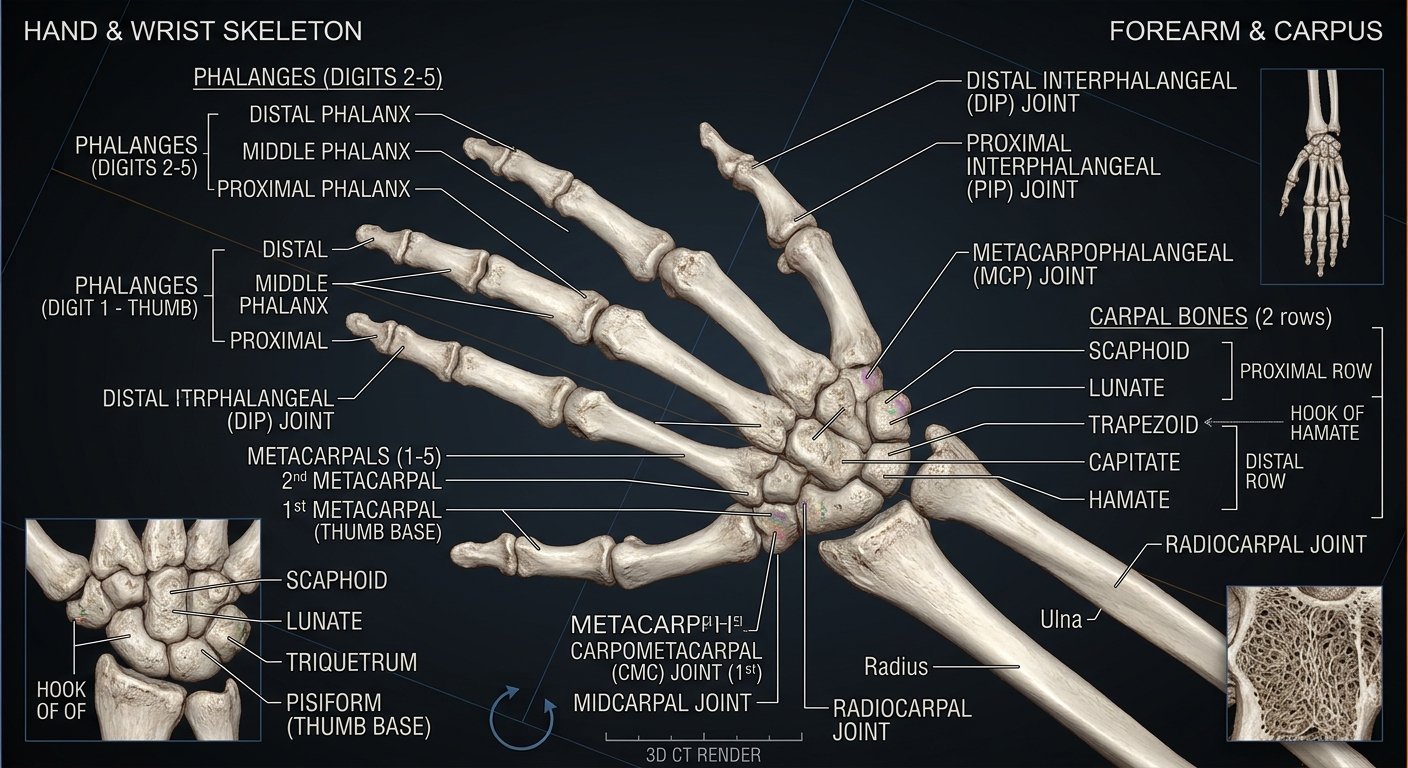
The human hand is a remarkable structure made up of 27 bones, numerous joints, ligaments, tendons, muscles, nerves and blood vessels. A hand X-ray allows us to see the bones and their alignment from inside the body.
A normal hand X-ray can help students understand the arrangement of the bones, while healthcare professionals use X-rays as an important imaging method for evaluating injuries and abnormalities.
🩻 What Is a Hand X-Ray?
A hand X-ray is a medical imaging examination that uses a small amount of X-ray radiation to create images of the bones and joints of the hand.
Because bones absorb more X-rays than soft tissues, they appear relatively bright on an X-ray image. This makes the technique particularly useful for examining the skeletal structure.
🦴 How Many Bones Are in the Hand?
A human hand contains 27 bones:
8 Carpal bones — wrist
5 Metacarpal bones — palm
14 Phalanges — fingers and thumb
Together, these bones create the framework that allows the hand to perform precise movements.
🔬 Main Parts Visible on a Hand X-Ray
1. Carpal Bones
The eight carpal bones are located between the forearm and the palm.
They are arranged in two rows:
Proximal row:
Scaphoid
Lunate
Triquetrum
Pisiform
Distal row:
Trapezium
Trapezoid
Capitate
Hamate
2. Metacarpals
There are five metacarpal bones. They form the skeletal framework of the palm.
They are numbered from 1 to 5, starting from the thumb side.
3. Phalanges
The fingers and thumb contain 14 phalanges.
The four fingers each have three:
Proximal phalanx
Middle phalanx
Distal phalanx
The thumb has two:
Proximal phalanx
Distal phalanx
👆 What About the Joints?
A hand X-ray can also show the spaces and alignment between bones.
Important joints include:
Wrist joints
Carpometacarpal (CMC) joints
Metacarpophalangeal (MCP) joints
Interphalangeal (IP) joints
The joint spaces and bone alignment can provide important information when evaluating the hand.
🩻 Common Hand X-Ray Views
Depending on the purpose of the examination, different views may be taken.
PA or AP View
Provides an overall view of the hand and its bones.
Oblique View
Shows the bones from an angled position and can help reveal certain fractures or abnormalities.
Lateral View
Shows the hand from the side and helps evaluate bone alignment and displacement.
Multiple views are often used because a single X-ray angle may not show every structure clearly.
🔎 What Can a Hand X-Ray Show?
Hand X-rays can help healthcare professionals evaluate conditions such as:
Bone fractures
Dislocations
Joint alignment
Arthritis-related changes
Bone deformities
Certain bone infections
Some bone lesions
Growth and development of bones
X-rays are also commonly used after injuries to determine whether a bone may be broken.
🎓 Why Is Hand X-Ray Important for Students?
Hand X-rays are excellent educational resources for learning human skeletal anatomy.
Students can use them to identify:
Carpals → Metacarpals → Phalanges → Joints → Bone alignment
They can also compare normal X-ray anatomy with educational examples of fractures and other abnormalities.
Hand X-ray images may be useful for:
Medical students
Nursing students
Radiology students
Biology students
Anatomy students
Teachers
Professors
Medical colleges
Universities
Training academies
🧠 Hand Anatomy: Quick Facts
Feature
Number
Total hand bones
27
Carpal bones
8
Metacarpal bones
5
Phalanges
14
Fingers
4
Thumb
1
📚 Hand X-Ray Study Guide
When studying a hand X-ray, try to identify the structures in this order:
Learning this sequence makes it easier to understand the complete skeletal anatomy of the hand.
💡 Did You Know?
The hand contains 27 bones, but its incredible range of movement comes from much more than bones alone. Tendons, muscles, ligaments, nerves and joints work together to provide strength, precision and coordination.
⚠️ Educational Disclaimer
This article is provided for educational and informational purposes. X-ray images should be interpreted by qualified healthcare professionals. This information is not intended to replace professional medical advice, diagnosis or treatment.
Hand X-Ray Keywords
hand x ray, hand xray, human hand x ray, hand anatomy, hand bones, hand bones anatomy, wrist x ray, carpal bones, metacarpal bones, phalanges, human skeletal anatomy, x ray anatomy, anatomy study, medical students, nursing students, radiology students, medical education, anatomy education, hand radiograph, human hand anatomy
Suggested Tags
Hand X-Ray, Hand Anatomy, Hand Bones, Human Hand X-Ray, X-Ray Anatomy, Carpal Bones, Metacarpal Bones, Phalanges, Wrist Anatomy, Human Anatomy, Medical Education, Anatomy Study, Radiology, Medical Students, Nursing Students, Tech X-Ray
A skull X-ray is a medical imaging examination that uses a small amount of X-ray radiation to create images of the bones of the skull. It can show the shape, position, and general condition of the skull and facial bones.
The skull protects the brain and supports important structures of the face. Because bone absorbs more X-rays than most surrounding soft tissues, the bones appear clearly on an X-ray image.
What Does a Skull X-Ray Show?
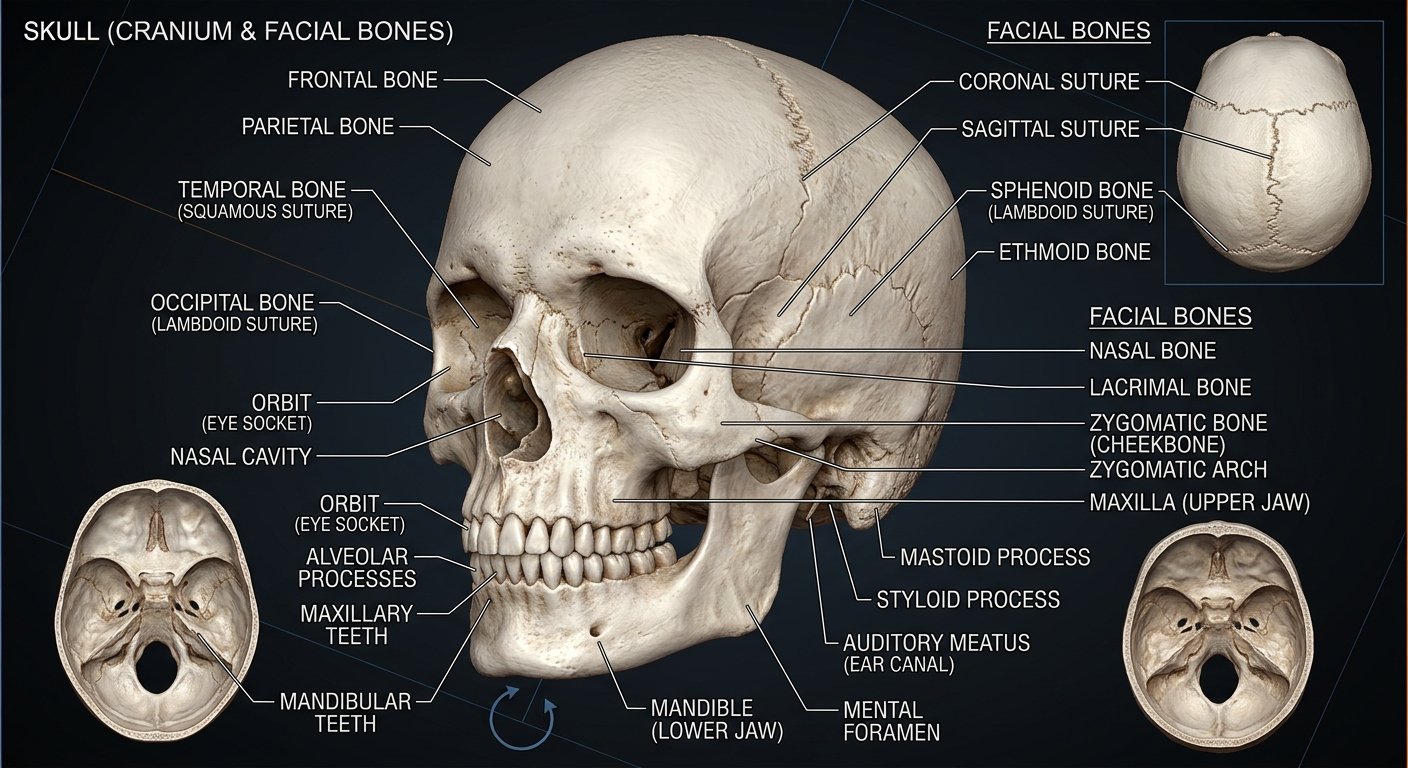
A skull X-ray can demonstrate many of the major bones and bony structures of the head.
Depending on the view taken, an image may show:
Frontal bone
Parietal bones
Temporal bones
Occipital bone
Sphenoid bone
Ethmoid bone
Nasal bones
Zygomatic bones
Maxilla
Mandible
Eye sockets (orbits)
Nasal cavity
Paranasal sinus regions
Sutures between skull bones
The exact structures visible depend on the X-ray projection and positioning.
Major Parts of the Skull
Frontal Bone
The frontal bone forms the forehead and contributes to the roof of the eye sockets. It is one of the major bones of the cranium.
Parietal Bones
There are two parietal bones, one on each side of the skull. They form a large portion of the upper sides and roof of the cranium.
Temporal Bones
The temporal bones are located on the sides of the skull near the ears. They contain important structures associated with hearing and balance.
Occipital Bone
The occipital bone forms much of the back and base of the skull. It contains the foramen magnum, a large opening through which the spinal cord connects with the brain.
Sphenoid Bone
The sphenoid is a complex bone located near the center of the skull. It contributes to the floor of the cranial cavity and the structure around the eye sockets.
Ethmoid Bone
The ethmoid bone is located between the eyes and contributes to the nasal cavity and the medial walls of the orbits.
Facial Bones
The skull also contains several facial bones, including the nasal bones, maxilla, zygomatic bones, and mandible.
How Does a Skull X-Ray Work?
X-ray imaging works by passing X-rays through the head toward a detector.
Different tissues absorb X-rays by different amounts. Dense bone absorbs more X-rays and therefore appears relatively bright on the resulting image, while areas that allow more X-rays to pass through appear darker.
The resulting image provides a two-dimensional representation of the structures captured by that particular projection.
Common Skull X-Ray Views
Different projections can be used to examine different parts of the skull.
Lateral View
A lateral projection produces a side view of the skull and can demonstrate the cranial bones, facial structures, and other anatomical landmarks.
AP or PA View
Anteroposterior (AP) and posteroanterior (PA) projections provide front-to-back views of the skull.
Towne View
The Towne projection can provide a view of the occipital region and other structures at the back of the skull.
The specific projections used depend on the clinical purpose of the examination.
Why Is a Skull X-Ray Performed?
Historically, skull X-rays have been used for evaluating certain bone abnormalities, fractures, foreign objects, and other conditions involving the skull.
Today, many head and brain-related situations are evaluated with other imaging technologies, such as CT, because CT can provide much more detailed cross-sectional information.
The appropriate imaging method depends on the clinical situation and the healthcare professional’s assessment.
Skull X-Ray vs CT Scan
A skull X-ray produces a relatively simple two-dimensional image.
A CT scan uses multiple X-ray measurements to create cross-sectional images and can provide considerably more detailed information about the skull and surrounding structures.
In situations where detailed assessment of a head injury or complex bone structure is required, CT may be preferred.
Interesting Facts About the Skull
The adult human skull contains 22 bones when the auditory ossicles are excluded.
The skull consists of the cranium and the facial skeleton.
Skull bones are connected by immovable joints called sutures.
The mandible is the largest and strongest bone of the facial skeleton.
The skull protects the brain and provides attachment points for many muscles.
The skull also contains openings called foramina, through which nerves and blood vessels pass.
What You Can See in Our X-Ray Image
The TECH X-RAY image above illustrates important structures of the skull, including parts of the cranium and facial skeleton.
Use the labels in the image to locate structures such as:
Frontal Bone → Parietal Bone → Temporal Bone → Occipital Bone → Sphenoid Bone → Ethmoid Bone → Nasal Bone → Zygomatic Bone → Orbit
This makes the image useful as a visual anatomy reference.
Feature
Details
Subject
Skull X-Ray
Category
Human Body
Imaging method
X-ray radiography
Main structures
Skull and facial bones
Image type
Two-dimensional projection
Related technology
CT scanning
Primary purpose
Visualization of bony structures
Important Note
This article is provided for educational and informational purposes. An X-ray image should be interpreted by a qualified healthcare professional when used for medical diagnosis or treatment
The human skeleton is the internal framework of the body. It provides support, gives the body its shape, protects important organs, and works together with muscles and joints to produce movement.
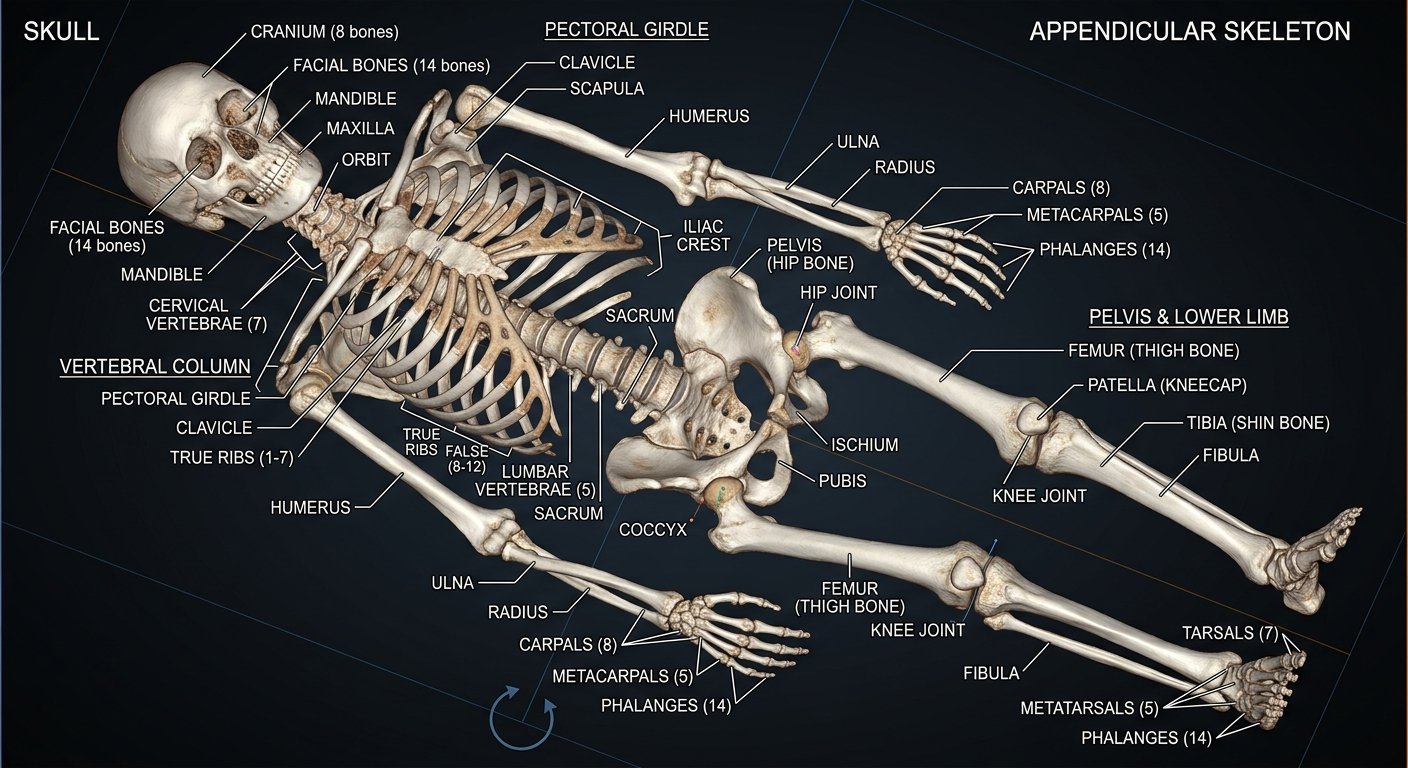
An adult human skeleton is generally described as having 206 bones. The skeleton is divided into two major sections: the axial skeleton and the appendicular skeleton
What Does a Skeleton X-Ray Show?
A full-body skeletal X-ray can demonstrate the major bones and their overall arrangement.
Depending on the image and projection, you may be able to identify:
Skull
Jaw
Clavicles
Shoulder blades
Rib cage
Sternum
Spine
Pelvis
Humerus
Radius
Ulna
Wrist and hand bones
Femur
Patella
Tibia
Fibula
Ankle and foot bones
X-rays are particularly useful for showing bone because bone absorbs more X-ray radiation than many of the surrounding soft tissues.
The Two Main Divisions of the Skeleton
1. Axial Skeleton
The axial skeleton forms the central axis of the body.
It includes the:
Skull
Vertebral column
Ribs
Sternum
Associated bones such as the hyoid and auditory ossicles
The adult axial skeleton contains about 80 bones.
Skull
The skull protects the brain and forms much of the structure of the head and face.
It includes cranial and facial bones such as the frontal, parietal, temporal, occipital, sphenoid, ethmoid, maxilla, zygomatic bones, nasal bones and mandible.
Vertebral Column
The vertebral column, or spine, supports the upper body and surrounds the spinal cord.
It is divided into:
Cervical vertebrae
Thoracic vertebrae
Lumbar vertebrae
Sacrum
Coccyx
Rib Cage
The rib cage consists primarily of the ribs and sternum. It forms a protective framework around organs within the chest, including the heart and lungs.
2. Appendicular Skeleton
The appendicular skeleton includes the bones of the limbs and the structures that connect the limbs to the axial skeleton.
It includes:
Shoulder girdles
Upper limbs
Pelvic girdle
Lower limbs
The appendicular skeleton contains about 126 bones.
Upper Limb Bones
The upper limb is designed for a wide range of movement.
Major bones include:
Clavicle
The clavicle, commonly called the collarbone, connects the shoulder region to the central skeleton.
Scapula
The scapula, or shoulder blade, is a flat bone located at the back of the shoulder.
Humerus
The humerus is the long bone of the upper arm.
Radius and Ulna
The radius and ulna are the two bones of the forearm.
Hand
The hand contains:
Carpals
Metacarpals
Phalanges
Together, these bones allow the hand to perform complex movements.
Lower Limb Bones
The lower limbs are primarily responsible for supporting body weight and producing movement during standing, walking and running.
Femur
The femur is the long bone of the thigh and is the largest bone in the human body.
Patella
The patella, or kneecap, is located at the front of the knee and is a sesamoid bone.
Tibia
The tibia is the larger weight-bearing bone of the lower leg.
Fibula
The fibula is the thinner bone running alongside the tibia.
Foot
The foot contains:
Tarsals
Metatarsals
Phalanges
These bones help provide support, balance and movement.
How Many Bones Are in the Human Skeleton?
The commonly accepted number for an adult human skeleton is 206 bones. However, the exact number can vary because some small accessory bones may be present and because certain bones are formed by fusion during development.
At birth, humans have more separate bones, and some fuse together as the body develops.
What Are the Main Functions of the Skeleton?
The skeletal system performs several important functions.
Support
Bones provide the structural framework that supports the body and helps maintain its shape.
Protection
Bones protect important organs.
For example:
Skull → protects the brain
Vertebral column → protects the spinal cord
Rib cage → helps protect the heart and lungs
Pelvis → helps protect organs within the pelvic region
Movement
Bones work with muscles and joints to create movement.
Muscles attach to bones through tendons, while joints allow controlled movement between bones.
Mineral Storage
Bones act as an important reservoir for minerals, particularly calcium and phosphorus.
Blood Cell Production
Red bone marrow in certain bones produces blood cells, a process called hematopoiesis.
Types of Bones
Bones can be classified according to their shape.
Long Bones
Long bones are longer than they are wide.
Examples:
Femur
Humerus
Tibia
Radius
Short Bones
Short bones provide stability and support.
Examples include many of the bones of the wrist and ankle.
Flat Bones
Flat bones often provide protection and broad surfaces for muscle attachment.
Examples include:
Skull bones
Ribs
Sternum
Scapula
Irregular Bones
These bones have complex shapes.
Examples include:
Vertebrae
Some facial bones
Sesamoid Bones
Sesamoid bones develop within certain tendons.
The patella is the largest and most familiar example.
What Can You See in a Skeleton X-Ray?
A skeletal X-ray can make many bones appear clearly because bone absorbs X-rays strongly compared with surrounding soft tissues.
In a full-body skeletal image, you can visually follow the body’s framework from the skull down through the spine, rib cage, pelvis and limbs.
The X-ray can therefore be an excellent visual tool for understanding how individual bones are arranged within the human body.
How Does an X-Ray Create the Image?
During an X-ray examination, X-rays pass through the body toward a detector.
Different tissues absorb different amounts of radiation.
Dense structures such as bone absorb more X-rays and therefore appear relatively bright on the resulting image, while areas where more X-rays pass through appear darker.
The result is a two-dimensional image representing the structures captured by that particular projection.
Skeleton X-Ray vs CT Scan
A conventional X-ray produces a two-dimensional projection.
A CT scan also uses X-rays, but a computer processes multiple measurements to create cross-sectional images and detailed views of internal structures.
Therefore, X-rays and CT scans have different strengths and are selected according to the clinical question.
Interesting Facts About the Human Skeleton
An adult human skeleton is generally described as containing 206 bones.
The skeleton is divided into axial and appendicular sections.
The femur is the longest and one of the strongest bones in the human body.
The smallest bones are the auditory ossicles inside the middle ear.
Bones are living tissues that continuously remodel.
Bone marrow has an important role in blood-cell production.
Bones store minerals such as calcium and phosphorus.
The skeleton works together with muscles, tendons, ligaments and joints to produce movement.
Quick Information
Feature
Details
Subject
Human Body Skeleton
Category
Human Body
Adult bones
Approximately 206
Main divisions
Axial and appendicular
Imaging method
X-ray radiography
Main functions
Support, protection, movement
Other functions
Mineral storage and blood-cell production
Related imaging
CT scan
Explore the Human Skeleton
The human skeleton is much more than a collection of individual bones. It is an integrated structural system that supports the body, protects vital organs, stores minerals and works with muscles to make movement possible.
The X-ray image above provides a visual way to explore this framework from the skull and spine to the hands, pelvis and feet.
Explore each region individually on TECH X-RAY to learn what every major bone does and how it fits into the human body.
Important Note
This article is intended for educational and informational purposes. An X-ray image used for medical diagnosis should be interpreted by a qualified healthcare professional.
Smartphone X-Ray — What’s Really Inside Your Phone?
A smartphone may look like a simple glass screen from the outside, but underneath that thin surface is a highly engineered combination of electronics, sensors, cameras, batteries, antennas and tiny mechanical components.
In this Tech X-Ray exploration, we’ll look beneath the display and discover what makes a modern smartphone work.
Although the exact internal layout differs between manufacturers and models, most modern smartphones contain many of the same fundamental components.
1. Display — The Face of the Smartphone
The display is the largest visible component of the phone.
Modern smartphones may use technologies such as:
OLED
AMOLED
LTPO OLED
LCD
The display assembly can contain multiple layers, including:
Protective glass
Touch-sensing layer
Display panel
Polarizing layers
Flexible circuit connections
Display controller
On OLED-based phones, individual pixels produce their own light, allowing manufacturers to make extremely thin displays.
2. Touchscreen Digitizer
When you touch the screen, the phone needs to determine exactly where your finger is.
The touchscreen uses a sensing layer to detect changes caused by your finger.
This information is sent to the touch controller, which communicates with the phone’s processor.
So when you tap an icon, the process is essentially:
At the center of the smartphone is the main processor, commonly called the SoC (System on Chip).
It performs enormous numbers of calculations every second.
A modern smartphone SoC can contain:
CPU
GPU
AI/NPU processor
Image signal processor
Memory controllers
Security hardware
Communication interfaces
The processor controls everything from opening applications to processing camera images and running games.
4. RAM — Temporary Working Memory
RAM allows the smartphone to keep frequently used information readily available.
When you open several applications, RAM helps the operating system keep those applications and their data available.
RAM is extremely fast compared with permanent storage, but its contents are normally lost when the phone is completely powered off.
5. Internal Storage
Your photos, videos, applications and documents are stored in non-volatile memory.
Modern smartphones commonly use flash storage.
The storage system contains memory chips that can hold data even when the phone is switched off.
A typical X-ray illustration can show these memory chips positioned close to the main processor.
6. Battery — The Power Source
The battery is usually one of the largest components inside a smartphone.
Modern smartphones commonly use lithium-ion or lithium-polymer battery technology.
The battery stores electrical energy and supplies power to the phone’s electronic circuits.
It powers:
Processor
Display
Cameras
Speakers
Sensors
Wireless systems
Charging circuits
The battery is usually a flat rectangular pack occupying a large portion of the internal space.
7. Battery Protection and Management
The battery is not connected directly to every component.
A battery-management and power-management system controls how electrical energy is distributed.
It can monitor and manage:
Battery voltage
Charging
Temperature
Current
Battery protection
Power distribution
This helps the phone operate safely and efficiently.
8. Motherboard — The Electronic Highway
The smartphone motherboard, also called the main logic board, contains many of the phone’s most important electronic components.
It may include:
Processor
RAM
Storage
Power-management ICs
Charging circuitry
Wireless communication chips
Audio circuitry
Display controllers
Camera interfaces
Unlike a desktop computer motherboard, a smartphone motherboard is extremely compact.
Some phones use multilayer circuit boards with microscopic electrical connections running through different layers.
9. Cameras
Modern smartphones can contain several cameras.
Depending on the model, there may be:
Main camera
Ultra-wide camera
Telephoto camera
Depth sensor
Front-facing camera
Each camera module can contain:
Lens system
Image sensor
Autofocus mechanism
Optical stabilization components
Flexible circuit connection
10. Image Sensor
Behind the camera lens is the image sensor.
The sensor converts incoming light into electrical signals.
The two major sensor technologies commonly encountered in digital cameras are:
CMOS
CCD
Modern smartphones predominantly use CMOS image sensors.
The sensor sends image data to the phone’s image-processing hardware, where computational photography can transform it into the final photograph.
11. Optical Image Stabilization
Some smartphone cameras contain tiny moving components that compensate for hand movement.
Optical image stabilization can physically shift part of the camera system or sensor to reduce the effects of movement.
This is an excellent feature to highlight in an X-ray animation because the camera module contains precision mechanical components despite its tiny size.
12. Flash
The small light next to the camera is usually an LED flash.
It provides additional illumination when taking photographs or recording video in dark conditions.
Inside the phone, the flash is connected to the motherboard through the electrical circuit.
13. Speakers
Smartphones usually contain at least one speaker system and often multiple speaker modules.
Speakers convert electrical signals into sound.
A typical speaker contains:
Permanent magnet
Voice coil
Diaphragm
Housing
The speaker’s movement creates pressure variations in the air that we perceive as sound.
14. Microphones
Smartphones contain several tiny microphones.
They can be used for:
Phone calls
Video recording
Voice messages
Noise cancellation
Voice assistants
Multiple microphones allow the phone to determine sound direction and help reduce unwanted background noise.
15. Vibration Motor / Haptic System
The vibration system produces tactile feedback.
Older phones commonly used simple rotating vibration motors, while modern smartphones may use more sophisticated linear haptic actuators.
The actuator can create precise vibrations for:
Notifications
Keyboard feedback
Touch controls
Alerts
Gaming
16. Charging Port
The charging port connects the smartphone to an external power source.
Depending on the phone, the connector may be:
USB-C
Lightning
Another proprietary connector
The port can carry:
Electrical power
Data
Accessory connections
Inside the phone, the connector is mounted to a circuit board or flexible assembly.
17. Wireless Charging System
Some smartphones support wireless charging.
A wireless charging system can contain a flat coil positioned behind the back panel.
The charging pad creates an electromagnetic field.
The coil inside the smartphone receives energy from that field and the charging circuitry converts and manages it for battery charging.
In an X-ray image, the charging coil can appear as a large circular or rectangular pattern behind the battery.
18. Cellular Antennas
Your smartphone needs antennas to communicate with cellular networks.
There can be multiple antennas positioned around the phone.
They support different radio functions and frequency bands.
The antenna system may be used for:
Cellular communication
4G
5G
Voice
Mobile data
The antennas are carefully positioned because the phone’s metal frame and other components can affect radio performance.
19. Wi-Fi and Bluetooth
The phone also contains wireless communication hardware for:
Wi-Fi
Bluetooth
Wireless accessories
Local networking
The radio chips communicate with the antennas to transmit and receive wireless signals.
20. NFC
Many modern smartphones contain an NFC (Near Field Communication) system.
NFC can be used for:
Contactless payments
Device pairing
Access cards
Reading NFC tags
The NFC antenna is often located near the rear portion of the phone.
21. GPS / GNSS System
Your smartphone can determine its location using satellite navigation systems.
Depending on the device, the positioning system can receive signals from systems such as:
GPS
Galileo
GLONASS
BeiDou
The phone combines satellite information with other sensors and network information to improve positioning.
22. Accelerometer
The accelerometer detects changes in movement and acceleration.
It can determine whether the phone is:
Moving
Tilting
Rotating
Being shaken
It is used for:
Screen rotation
Gaming
Fitness applications
Motion detection
System controls
23. Gyroscope
The gyroscope measures rotational movement.
Together, the gyroscope and accelerometer provide the phone with detailed information about its orientation and movement.
These sensors are especially important for:
Gaming
Augmented reality
Navigation
Camera stabilization
Motion tracking
24. Proximity Sensor
The proximity sensor detects when an object is close to the phone.
During a phone call, it can detect when your face is near the display and help prevent accidental touches.
Modern smartphones may use different sensing technologies depending on the design.
25. Ambient Light Sensor
The ambient light sensor measures the surrounding light level.
The phone can use this information to automatically adjust display brightness.
This helps make the screen easier to see while also managing power consumption.
26. Biometrics
Many smartphones contain biometric hardware.
Depending on the model, this may include:
Fingerprint sensor
Face-recognition cameras
Infrared sensors
Depth-sensing hardware
These systems allow the phone to identify or authenticate the user.
27. Cooling System
Smartphones generate heat, especially during:
Gaming
Video recording
Fast charging
High-performance computing
To move heat away from important components, some smartphones use:
Graphite sheets
Copper components
Vapor chambers
Thermal pads
Heat spreaders
A vapor chamber is particularly interesting in an X-ray visualization because it can appear as a thin, large-area thermal component.
28. Motherboard and Flexible Cables
Not every component is connected directly with rigid wiring.
Smartphones use flexible printed circuits, often called flex cables.
These connect components such as:
Display
Cameras
Speakers
Charging port
Buttons
Sensors
Motherboard
The flex cables allow manufacturers to fit many components into an extremely thin body.
29. Buttons and Switches
Physical buttons can include:
Power button
Volume buttons
Action/function buttons
Tiny switches underneath these buttons send electrical signals to the phone’s control circuitry.
30. Frame and Structural Components
The outer frame protects and supports the internal components.
Depending on the smartphone, the structure may contain:
Aluminum
Stainless steel
Titanium
Magnesium
Glass
Engineering plastics
The frame also contributes to antenna performance and structural rigidity.
31. Water and Dust Protection
Many modern smartphones are designed with seals and gaskets around openings.
These can help reduce the entry of:
Water
Dust
Moisture
Protection levels vary significantly between models, so an exact rating should always be checked for the particular phone.
32. What Does a Smartphone X-Ray Reveal?
If the outer shell and display are made transparent, we can visualize the phone as several layers.
One of the greatest engineering challenges is fitting all these components into a device only a few millimeters thick.
Manufacturers use:
Miniaturized chips
Stacked circuit boards
Flexible cables
Compact batteries
Small sensors
Integrated circuits
Custom-designed components
The result is essentially a complete computer, camera, communication device and sensor platform inside a pocket-sized object.
35. The Most Interesting Parts for a Tech X-Ray
For your interactive Tech X-Ray website, these should become clickable cards:
📱 DISPLAY
Explore the layers beneath the glass.
🔋 BATTERY
See the largest energy-storage component.
🧠 PROCESSOR
Discover the electronic brain.
📷 CAMERA
Explore lenses, sensors and stabilization.
💾 STORAGE
See where your photos, videos and applications are stored.
📡 ANTENNAS
Discover how the phone communicates wirelessly.
🔊 SPEAKERS
See the tiny components that create sound.
🎤 MICROPHONES
Explore how your phone captures your voice.
🧭 SENSORS
Discover the accelerometer, gyroscope, proximity and light sensors.
⚡ CHARGING
Follow electricity from the charging port to the battery.
❄️ COOLING
See how heat moves away from the processor.
Final Takeaway
A smartphone is essentially a miniature computer, camera, communication device, navigation system and sensor platform combined into one small enclosure.
Behind the glass display are billions of electronic components working together with mechanical parts such as camera actuators, speakers, vibration systems and buttons.
The battery provides energy.
The processor performs calculations.
The memory stores information.
The cameras capture light.
The sensors detect movement and surroundings.
The antennas communicate with the outside world.
And the software coordinates all of these systems.
The next time you hold a smartphone, remember that beneath its smooth glass surface is an incredibly dense piece of engineering.
BMW Motorcycle X-Ray — What’s Inside This Machine?
What does a BMW motorcycle actually look like underneath its impressive exterior?
From the outside, a BMW motorcycle may appear to be a combination of wheels, bodywork, a fuel tank, an engine and a seat. But inside is a sophisticated network of mechanical, electrical and electronic systems designed to work together.
In this Tech X-Ray exploration, we look beneath the surface of a BMW Motorrad motorcycle and discover the major components that transform fuel and electrical energy into controlled motion.
BMW Motorrad produces several motorcycle families with different engine architectures, including boxer twins, inline four-cylinder engines and six-cylinder engines. Therefore, the exact internal layout depends on the model.
1. The Engine — The Heart of the BMW
The engine is the primary source of mechanical power.
One of BMW Motorrad’s most recognizable engine designs is the flat-twin boxer engine.
In a boxer engine, the two cylinders are positioned horizontally opposite each other. The pistons move outward and inward in opposite directions, creating the characteristic layout and balance of the engine.
BMW has used boxer engines in motorcycles for decades, making the design one of the defining features of BMW Motorrad.
Depending on the BMW motorcycle, the engine may instead be an inline two-cylinder, inline four-cylinder or six-cylinder design.
2. BMW Boxer Engine
The boxer engine is particularly interesting in an X-Ray illustration.
A typical BMW boxer engine contains:
Two horizontally opposed cylinders
Pistons
Piston rings
Connecting rods
Crankshaft
Cylinder heads
Camshafts
Valves
Spark plugs
Combustion chambers
Oil passages
Cooling passages
Fuel injectors
The cylinders extend outward from the central crankcase.
This arrangement gives the motorcycle a distinctive engine shape that can be clearly seen in a transparent or X-ray-style illustration.
3. BMW ShiftCam Technology
Some modern BMW boxer motorcycles use BMW ShiftCam technology.
ShiftCam changes the intake-side valve timing and valve lift according to operating conditions.
The system uses different cam profiles for different operating conditions.
A lower-load cam profile is designed to support smooth operation and efficiency, while the higher-load profile is designed to provide stronger performance.
BMW explains that its ShiftCam system uses a one-piece intake camshaft with different cam profiles and an actuator that shifts the camshaft axially.
In an X-Ray image, this would be an excellent component to highlight with a label:
BMW ShiftCam → Variable Intake Valve Timing & Lift
4. Pistons and Combustion Chambers
Inside each cylinder is a piston.
The piston moves back and forth as combustion takes place.
The four basic stages of a four-stroke engine are:
Intake
Compression
Power
Exhaust
The combustion pressure pushes the piston, and the connecting rod transfers this force to the crankshaft.
The crankshaft converts this reciprocating movement into rotation.
That rotational energy eventually becomes rear-wheel drive.
5. Cylinder Heads
The cylinder heads sit at the outer ends of the boxer engine.
They contain important components such as:
Intake valves
Exhaust valves
Camshafts
Valve springs
Spark plugs
Combustion chambers
The cylinder heads are particularly visible on a BMW boxer motorcycle because the cylinders extend horizontally from the engine.
This is one of the easiest features to identify in a BMW X-Ray.
6. Fuel Injection System
Modern BMW motorcycles use electronic fuel-management systems.
The fuel system can include:
Fuel tank
Fuel pump
Fuel filter
Fuel lines
Fuel injectors
Throttle bodies
Sensors
Electronic engine management
The injector delivers fuel into the intake system according to commands from the engine-management system.
The quantity and timing of fuel delivery can change according to engine speed, throttle position, temperature and other operating conditions.
7. Air Intake System
The engine also needs a controlled supply of air.
Air generally travels through:
Air Intake → Air Filter → Throttle Body → Intake System → Cylinder
The air filter removes dust and particles before the air reaches the engine.
The throttle system controls how much air enters the engine.
8. Crankshaft
At the center of the engine is the crankshaft.
The pistons are connected to the crankshaft through connecting rods.
The crankshaft performs an important conversion:
Piston movement → Crankshaft rotation
The rotating crankshaft provides the mechanical power that is transferred through the drivetrain.
9. Clutch
The clutch connects and disconnects the engine from the transmission.
When the rider changes gear, the clutch allows engine power to be temporarily interrupted.
BMW motorcycles can use different clutch designs depending on the model.
Some models also feature anti-hopping or slipper-clutch technology.
10. Gearbox / Transmission
The gearbox converts engine speed and torque into useful drive ratios.
A motorcycle transmission contains:
Gears
Shafts
Bearings
Shift mechanism
Selector forks
Clutch connection
Different gears allow the motorcycle to operate efficiently at different speeds.
BMW Motorrad uses different drivetrain arrangements across its motorcycle range.
11. Shaft Drive — A Distinctive BMW Feature
One of the most interesting things to show in a BMW motorcycle X-Ray is the shaft-drive system.
Unlike a chain-driven motorcycle, a shaft-drive BMW can transfer power from the gearbox to the rear wheel through a driveshaft and rear differential/final-drive assembly.
BMW describes its Paralever/cardanic system as using a cardan shaft between the gearbox and rear wheel, integrated into the rear suspension architecture on applicable models.
This makes the drivetrain look very different from a conventional chain-and-sprocket motorcycle.
12. Paralever Rear Suspension
The Paralever system is another distinctive BMW engineering feature.
It combines rear-wheel suspension and shaft-drive architecture.
The system is designed to reduce unwanted suspension effects associated with shaft-drive torque reactions.
The rear assembly can include:
Swingarm
Driveshaft
Universal joints
Rear differential/final drive
Suspension strut
Rear wheel
Brake assembly
BMW describes the Paralever system as a parallelogram-type arrangement that helps compensate for forces generated by the cardan drive.
For your X-Ray graphic, this would be an excellent callout:
PARALEVER → Rear Suspension + Shaft Drive
13. Telelever Front Suspension
Some BMW motorcycles use another distinctive system called Telelever.
Unlike a conventional motorcycle fork, Telelever separates some of the wheel-guidance and suspension functions.
The front wheel is guided by fork tubes, while a separate wishbone-like component and central spring/damper arrangement perform important suspension functions.
BMW states that the Telelever design separates wheel alignment from suspension/damping functions and is intended to reduce front-end dive under braking.
In an X-Ray image, the Telelever should be highlighted clearly because it is one of BMW Motorrad’s most recognizable chassis technologies.
14. Front Wheel and Brake System
The front wheel is connected to the suspension and braking system.
Major components include:
Wheel rim
Tire
Wheel bearings
Axle
Brake disc
Brake caliper
Brake pads
Brake lines
When the rider applies the brake, hydraulic pressure moves the brake pads against the disc, converting kinetic energy into heat.
15. Rear Wheel
The rear wheel receives the engine’s final mechanical output.
On shaft-drive BMW models, the power path reaches the rear wheel through the driveshaft and final-drive assembly.
The rear wheel assembly may contain:
Wheel
Tire
Brake disc
Brake caliper
Final-drive housing
Bearings
Axle
16. BMW Frame — The Skeleton
The frame provides the structural foundation of the motorcycle.
It supports and connects:
Engine
Steering system
Fuel tank
Suspension
Seat
Rear frame
Electrical equipment
The exact frame construction depends on the BMW model.
For example, BMW’s R 1300 GS introduced a redesigned sheet-metal shell main frame and a die-cast aluminum rear section.
17. Fuel Tank
The fuel tank stores the motorcycle’s fuel.
Inside or around the tank assembly can be components associated with:
Fuel pump
Fuel-level sensor
Fuel pickup
Fuel lines
Ventilation system
The fuel then travels toward the injection system.
18. Cooling System
The engine produces substantial heat during combustion.
Depending on the BMW model, cooling can involve:
Air
Oil
Liquid coolant
Radiators
Cooling passages
Water pump
Thermostat
Cooling fan
Modern BMW boxer engines can use air/liquid cooling depending on the generation and model.
The cooling system helps keep engine temperatures within their intended operating range.
19. Exhaust System
After combustion, exhaust gases leave the cylinders through the exhaust valves.
BMW motorcycles can use electronically controlled engine-management and catalytic-converter systems to manage emissions and performance.
20. Electrical System
Modern BMW motorcycles contain an extensive electrical network.
It can include:
Battery
Alternator/generator
Starter motor
ECU
Sensors
Relays
Fuses
Wiring harness
Headlight
Turn indicators
Brake lights
Instrument display
Electronic control modules
The electrical system powers everything from starting the engine to controlling sophisticated rider-assistance functions.
21. ECU — The Electronic Brain
The electronic control unit receives information from sensors and controls various motorcycle systems.
Depending on the model, electronic systems can monitor:
Engine speed
Throttle position
Engine temperature
Wheel speed
Air conditions
Gear position
Brake conditions
Acceleration
Motorcycle movement
The ECU and other control modules can then adjust engine and chassis functions.
22. ABS and Electronic Rider Assistance
BMW motorcycles can be equipped with advanced electronic rider-assistance systems.
Depending on model and equipment, these can include:
ABS
Traction control
Riding modes
Hill-start assistance
Engine-brake control
Dynamic brake control
Tire-pressure monitoring
Electronic suspension control
Cruise control
For example, BMW’s R 1300 GS includes systems such as Dynamic Traction Control, Engine Drag Torque Control, Dynamic Brake Assist and Hill Start Control.
These systems make the motorcycle much more electronically sophisticated than older motorcycles.
23. Battery
The battery provides electrical energy for starting and operating electrical systems.
It works together with the motorcycle’s charging system.
The basic electrical cycle is:
Battery → Electrical Systems
and while the engine runs:
Engine → Alternator → Charging System → Battery
24. Dashboard and TFT Display
Many modern BMW motorcycles use digital displays.
Depending on the model, the display can provide information such as:
Speed
RPM
Gear
Fuel level
Engine temperature
Riding mode
Navigation
Trip information
Warning messages
Connectivity information
This is effectively the rider’s information center.
25. Sensors — The Hidden Network
One of the most interesting things about a modern BMW X-Ray is the number of sensors hidden throughout the motorcycle.
Sensors can monitor:
Wheel speed
Engine position
Engine temperature
Throttle position
Air conditions
Brake conditions
Motorcycle acceleration
Lean or movement conditions
The information is sent to electronic control systems that continuously adjust motorcycle operation.
26. What the BMW X-Ray Reveals
If we remove the exterior bodywork using an X-Ray effect, the motorcycle can be divided into several layers.
Outer Layer
Fuel tank
Seat
Body panels
Headlight
Windscreen
Mudguards
Structural Layer
Frame
Subframe
Steering assembly
Swingarm
Mechanical Layer
Boxer engine
Clutch
Gearbox
Driveshaft
Final drive
Brakes
Suspension
Wheels
Electrical Layer
Battery
ECU
Sensors
Wiring
Lighting
Display
Control Layer
ABS
Traction control
Riding modes
Engine management
Electronic suspension
Rider-assistance systems
27. How Does a BMW Motorcycle Move?
The basic power path on a shaft-drive BMW can be simplified as:
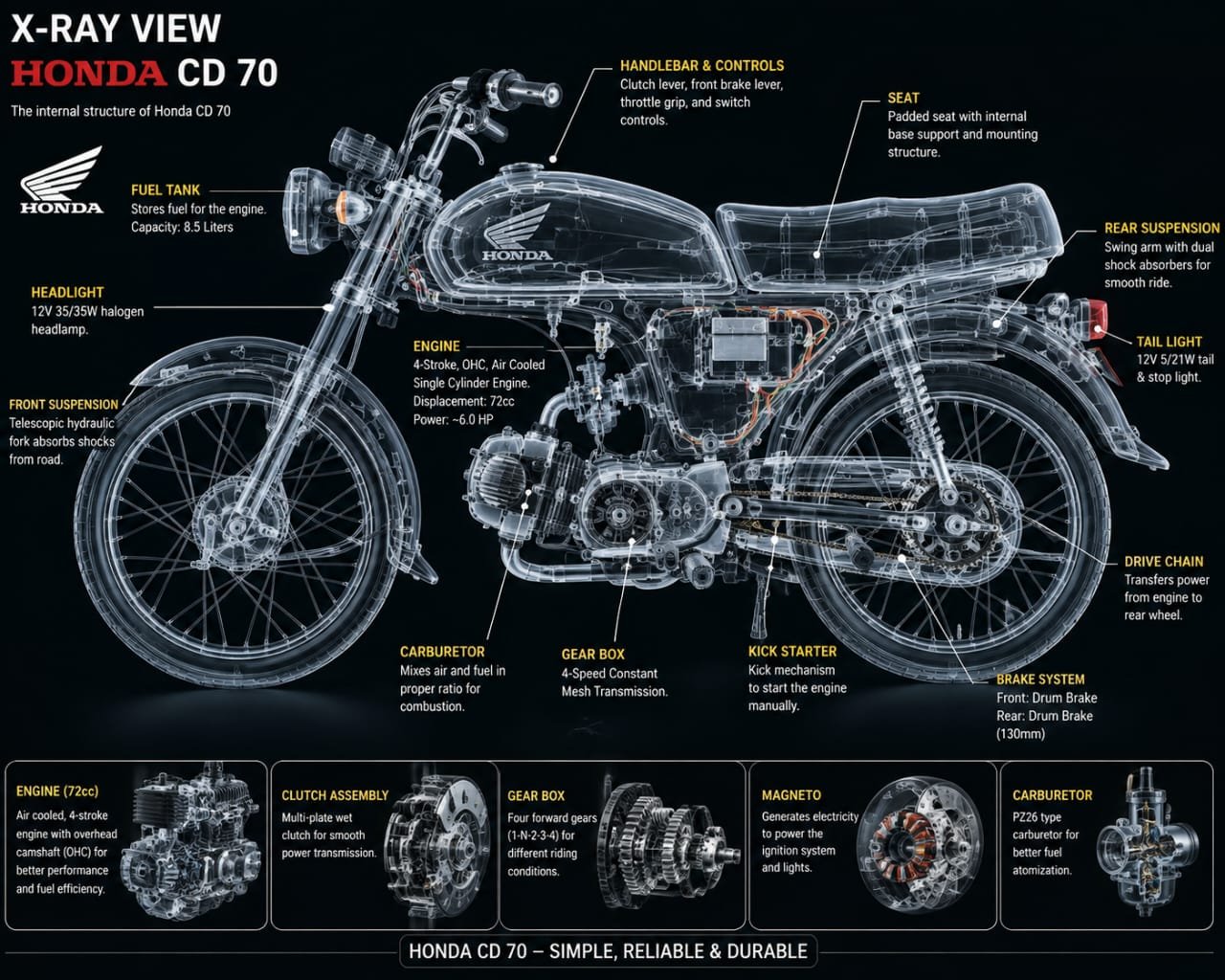
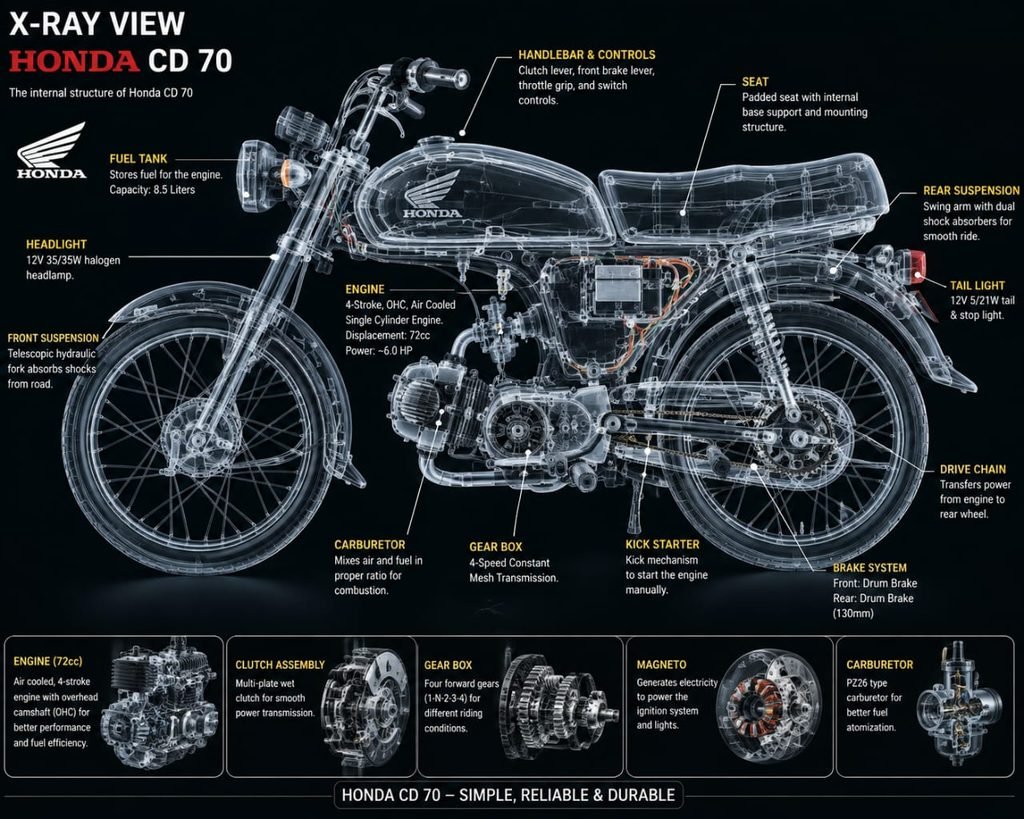
Ever wondered what is actually hidden inside a Honda motorcycle?
From the outside, a Honda bike may look simple—two wheels, a fuel tank, an engine and a seat. But beneath its body is a carefully engineered system of mechanical, electrical and structural components working together to produce power, control speed, provide braking and keep the motorcycle stable.
In this X-Ray-style exploration, we look beneath the outer bodywork and identify the major components that make a Honda motorcycle work.
1. Engine — The Heart of the Motorcycle
The engine is the main power-producing unit of the motorcycle.
Depending on the Honda model, the engine configuration can vary considerably. Small commuter motorcycles, scooters, sport bikes and large touring motorcycles use different engine designs and technologies.
Inside a conventional four-stroke motorcycle engine, the major components include:
Cylinder
Piston
Piston rings
Connecting rod
Crankshaft
Valves
Camshaft
Spark plug
Combustion chamber
Engine oil passages
Cooling system
Crankcase
When the engine is running, the piston moves inside the cylinder. The connecting rod transfers this movement to the crankshaft, which converts the piston’s reciprocating motion into rotational motion.
That rotation ultimately becomes the mechanical power used to turn the rear wheel.
2. Fuel System
The fuel system supplies the engine with the fuel it needs for combustion.
Modern Honda motorcycles commonly use programmed fuel injection (PGM-FI), although the exact system depends on the model and market.
The fuel system can include:
Fuel tank
Fuel pump
Fuel filter
Fuel injector
Throttle body
Fuel lines
Engine control electronics
In a fuel-injected system, the electronic control system determines how much fuel should be delivered according to operating conditions.
This helps provide responsive engine operation and efficient fuel use. Honda describes PGM-FI as a computerized fuel-injection system used across its motorcycle range.
3. Air Intake System
An engine needs both fuel and air.
Air enters through the intake system and passes through the air filter before reaching the engine.
The system may include:
Air intake
Air filter
Air box
Throttle body
Intake manifold
Intake valves
The air filter is particularly important because it helps prevent dust and other particles from entering the engine.
4. Combustion Chamber
Inside the cylinder is the combustion chamber.
This is where the air-fuel mixture is burned.
The basic four-stroke cycle consists of:
Intake
Compression
Power
Exhaust
The spark plug ignites the compressed mixture in a gasoline engine. The resulting combustion creates pressure that pushes the piston downward.
That movement is transferred through the connecting rod to the crankshaft.
5. Crankshaft and Connecting Rod
The crankshaft is one of the most important moving components inside the engine.
The piston moves up and down, while the crankshaft rotates.
The connecting rod links these two components and transfers the piston’s force to the crankshaft.
The crankshaft then provides rotational power that can be transferred through the transmission and final drive to the rear wheel.
6. Transmission and Clutch
Engine power cannot simply be sent directly to the rear wheel.
The transmission allows the motorcycle to use different gear ratios.
A typical manual motorcycle drivetrain can include:
Clutch
Primary drive
Transmission gears
Gear selector mechanism
Countershaft
Final drive
The clutch allows the rider to temporarily disconnect engine power from the transmission when starting, stopping or changing gears.
The selected gear determines the relationship between engine speed and wheel speed.
7. Final Drive
After passing through the transmission, power reaches the rear wheel through the final-drive system.
Depending on the motorcycle, this can involve:
Chain and sprockets
Belt drive
Shaft drive
Many conventional Honda motorcycles use a chain-and-sprocket arrangement.
The front sprocket transfers rotational force through the chain to the larger rear sprocket, which rotates the rear wheel.
8. Frame — The Skeleton of the Bike
The frame is essentially the motorcycle’s skeleton.
It supports and connects many major components, including:
Engine
Fuel tank
Seat
Steering assembly
Rear suspension
Swingarm
Electrical components
The frame also plays an important role in handling and stability.
Honda develops different frame structures for different motorcycle categories. For example, Honda’s larger and performance-oriented motorcycles can use highly engineered aluminum or steel chassis designs depending on the model.
9. Front Suspension
The front suspension connects the front wheel to the motorcycle while allowing the wheel to move vertically over bumps.
On many motorcycles, telescopic forks are used.
A conventional fork assembly contains components such as:
Fork tubes
Fork sliders
Springs
Damping components
Fork oil
Triple clamps
The suspension absorbs road impacts and helps keep the front tire in contact with the road.
Honda also uses more specialized suspension designs on certain motorcycles. For example, the Gold Wing uses a double-wishbone front suspension rather than conventional telescopic forks.
10. Rear Suspension
At the rear, the suspension normally works through the swingarm and shock absorber.
Major components can include:
Swingarm
Rear shock absorber
Spring
Linkage mechanism
Rear axle
Honda’s Pro-Link system, used on various models, uses a linkage arrangement to provide progressive suspension characteristics.
11. Braking System
The brakes convert the motorcycle’s motion into heat through friction, allowing the rider to slow down or stop.
A motorcycle braking system can include:
Brake lever or pedal
Brake master cylinder
Brake fluid
Brake hose
Brake caliper
Brake pads
Brake disc
Rear brake assembly
Honda has developed several braking technologies, including Combined Brake Systems and ABS.
ABS monitors wheel speed and can reduce brake pressure when a wheel approaches lock-up, helping maintain stability during hard braking.
Not every Honda motorcycle has the same braking equipment, so the exact system depends on the model.
12. Wheels and Tires
The wheels provide the physical connection between the motorcycle and the road.
Each wheel can contain:
Rim
Tire
Inner components depending on wheel design
Wheel bearings
Axle
Brake disc or drum
The tires provide traction for:
Acceleration
Braking
Cornering
Stability
Tire pressure is also important because incorrect pressure can affect handling, braking and tire wear.
13. Steering System
The steering system allows the rider to control the direction of the motorcycle.
Major components include:
Handlebar
Steering stem
Triple clamps
Fork assembly
Steering bearings
When the rider turns the handlebar, the steering assembly changes the direction of the front wheel.
14. Electrical System
Modern motorcycles contain considerably more electronics than older motorcycles.
The electrical system can include:
Battery
Alternator/stator
Regulator/rectifier
Starter motor
ECU
Ignition system
Sensors
Wiring harness
Fuses
Relays
Headlight
Turn signals
Brake lights
Instrument cluster
The battery supplies electrical energy for starting and various electrical systems, while the charging system replenishes the battery when the engine is running.
15. ECU — The Motorcycle’s Electronic Brain
On electronically controlled Honda motorcycles, the Engine Control Unit (ECU) receives information from sensors and controls various engine functions.
Depending on the motorcycle, sensors can monitor things such as:
Engine temperature
Throttle position
Intake conditions
Engine speed
Crankshaft position
Oxygen/exhaust conditions
Wheel speed on electronically equipped models
The ECU uses this information to control systems such as fuel injection and ignition.
More advanced Honda motorcycles can also use electronic systems to manage traction, braking and other riding functions.
16. Cooling System
Engine combustion generates considerable heat.
Depending on the motorcycle design, cooling may be provided by:
Air cooling
Liquid cooling
Oil cooling or combinations of cooling technologies
A liquid-cooled engine generally includes:
Radiator
Coolant
Water pump
Thermostat
Cooling passages
Hoses
Cooling fan
The cooling system helps maintain the engine within its intended operating temperature range.
17. Exhaust System
After combustion, exhaust gases must leave the engine.
The exhaust system can include:
Exhaust valve
Exhaust port
Exhaust header
Exhaust pipe
Catalytic converter
Muffler
The system carries exhaust gases away from the engine while helping reduce noise and, on equipped models, harmful emissions.
18. Fuel Tank
The fuel tank stores the motorcycle’s fuel.
Inside or around the fuel tank assembly you may find components associated with:
Fuel pump
Fuel-level sensing
Fuel pickup
Fuel lines
Tank ventilation
The exact arrangement varies between Honda motorcycle models.
19. Battery and Charging System
The motorcycle’s battery provides electrical power when required, especially during starting.
The charging system generally includes:
Alternator/stator
Regulator/rectifier
Battery
The alternator generates electrical power while the engine runs. The regulator/rectifier manages the generated electricity so it can be used by the motorcycle’s electrical system and battery.
20. What an X-Ray View Reveals
When the motorcycle’s exterior bodywork is visually removed, the relationship between its components becomes much easier to understand.
You can imagine the motorcycle as several interconnected layers:
Outer Layer
Fuel tank
Side covers
Mudguards
Headlight
Seat
Body panels
Structural Layer
Frame
Swingarm
Steering assembly
Subframe
Mechanical Layer
Engine
Clutch
Transmission
Chain and sprockets
Suspension
Brakes
Wheels
Electrical Layer
Battery
ECU
Sensors
Wiring
Ignition
Lighting
Together, these systems form one complete motorcycle.
Brake Control → Brake System → Wheel → Tire → Road
The suspension works continuously between the wheels and chassis to help maintain contact with the road.
Why Is the Honda Motorcycle Designed This Way?
A motorcycle must balance several competing requirements:
Low weight
Strength
Stability
Fuel efficiency
Engine performance
Rider comfort
Braking performance
Suspension performance
Reliability
Emissions control
Honda uses different engineering solutions depending on the intended purpose of the motorcycle.
A small commuter bike may prioritize simplicity, economy and practicality, while a high-performance sport bike may prioritize acceleration, cornering, braking and electronic control.
Important Note
There is no single internal layout shared by every Honda motorcycle.
A Honda commuter motorcycle, scooter, sport bike, adventure motorcycle and Gold Wing can have substantially different engines, transmissions, frames, suspension systems and electronics.
Therefore, an actual X-ray illustration should be labeled according to the specific Honda model and year being shown.
Final Takeaway
A Honda motorcycle is much more than an engine with two wheels.
Inside its body is a coordinated system of mechanical structures, moving components, electronics, fuel and air systems, suspension, brakes and drivetrain components.
The engine creates the power, the transmission manages that power, the final drive sends it to the wheel, the frame holds the machine together, the suspension manages road movement, and the braking and electronic systems help the rider control it.
That’s what makes the Honda motorcycle an impressive piece of mechanical engineering—and an excellent subject for an X-ray-style exploration.