Digital Camera X-Ray
Digital Camera X-Ray: What’s Inside a Digital Camera?
A digital camera may look like a simple device from the outside, but inside it contains a complex combination of optical, mechanical and electronic components.
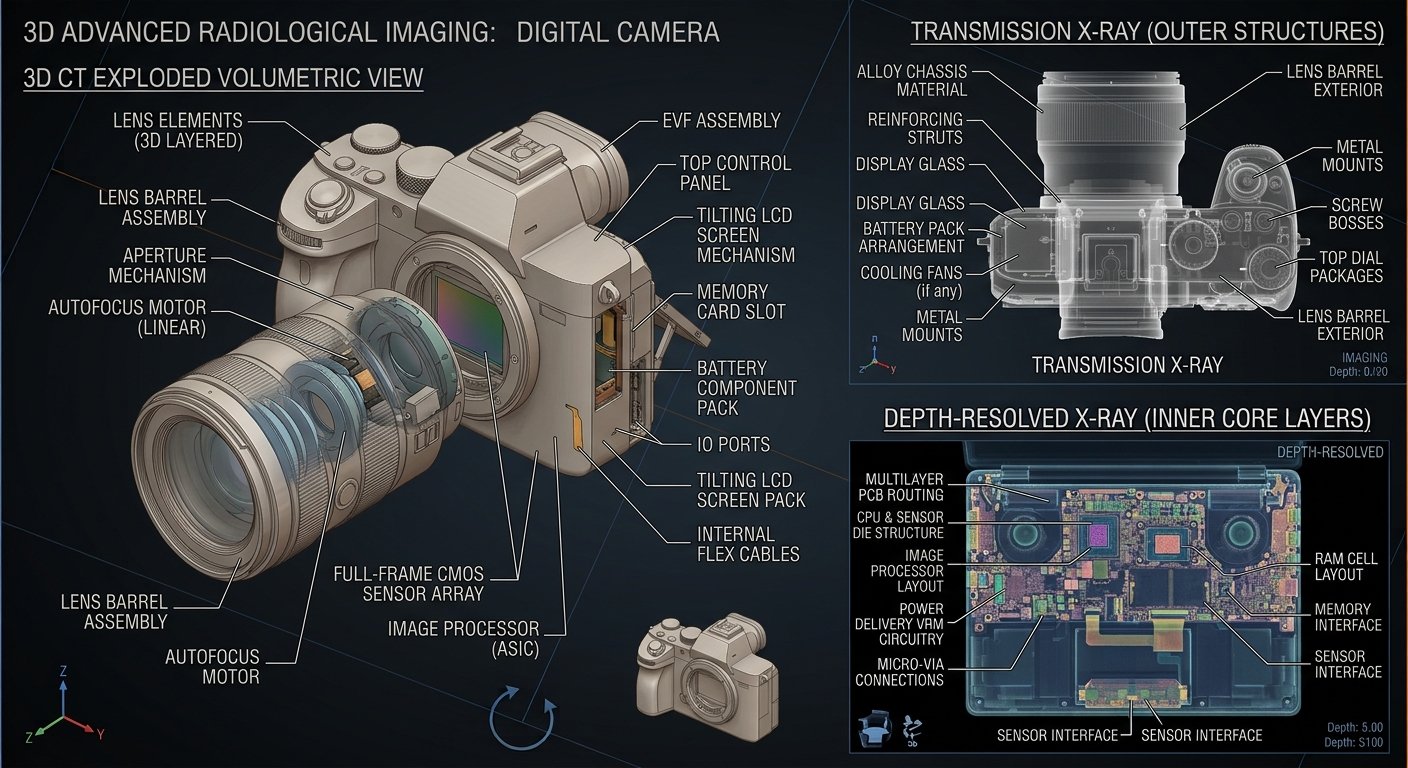
An X-ray view can reveal the hidden internal arrangement of the camera without opening its outer housing. From the lens assembly to the image sensor, circuit boards and battery compartment, an X-ray can provide a fascinating look at the technology inside a digital camera.
📷 What Is a Digital Camera X-Ray?
A digital camera X-ray is an imaging view of a camera’s internal structure produced using X-ray imaging equipment.
Unlike a normal photograph, which shows the outside of the camera, an X-ray can reveal components hidden beneath the casing.
This makes X-ray imaging an interesting way to explore the internal architecture of electronic devices.
🔍 What Can You See Inside a Digital Camera?
Depending on the camera model and X-ray image, several internal components may be visible.
1. Lens Assembly
The lens is one of the most recognizable components.
Inside a camera lens are multiple optical elements designed to control how light enters the camera.
In cameras with zoom lenses, the X-ray may reveal the arrangement of several lens groups and the mechanical structures that allow them to move.
2. Image Sensor
The image sensor is one of the most important electronic components in a digital camera.
It converts incoming light into electronic signals that can be processed into a digital image.
Common sensor technologies include:
- CMOS
- CCD
The sensor is positioned behind the lens system.
3. Circuit Boards
A digital camera contains one or more electronic circuit boards.
These boards may contain:
- Integrated circuits
- Processors
- Memory components
- Connectors
- Capacitors
- Resistors
- Power-management components
The circuit boards control image processing, storage, communication and many other camera functions.
4. Shutter Mechanism
Many digital cameras contain a mechanical shutter.
The shutter controls the period during which light reaches the image sensor.
In an X-ray image, mechanical components of the shutter assembly may appear as small, precisely arranged structures near the sensor and lens pathway.
5. Battery Compartment
Portable digital cameras require a battery to power their electronic systems.
The battery compartment and electrical contacts may be visible in an X-ray image.
The battery supplies power to components such as the processor, display, sensor and lens mechanisms.
6. Flash Unit
Many cameras include an integrated flash.
The flash system may contain:
- Flash tube
- Capacitor
- Electrical circuitry
- Reflector
The capacitor stores electrical energy that can be released rapidly to produce the flash.
7. Display and Control Components
Digital cameras often contain an LCD display and several control buttons.
Behind these external controls are electronic switches, connectors and circuit-board components.
An X-ray can reveal how these components are positioned inside the camera body.
🧠 How Does a Digital Camera Work?
The basic process can be simplified into several steps:
Light → Lens → Aperture/Shutter → Image Sensor → Processor → Memory → Digital Image
The lens focuses light onto the image sensor.
The sensor converts the incoming light into electronic information.
The camera’s processor then processes this information and creates a digital image that can be stored on memory or transferred to another device.
🩻 What Does an X-Ray Reveal?
A digital camera X-ray can help visualize the internal arrangement and density of components.
Depending on the imaging technique, you may be able to identify:
- Lens elements
- Lens housing
- Image sensor area
- Circuit boards
- Integrated circuits
- Battery
- Flash capacitor
- Mechanical gears
- Motors
- Connectors
- Screws and structural supports
The exact appearance varies significantly between camera models.
⚙️ Why Are There So Many Small Components?
Modern digital cameras combine several different technologies into a relatively small space.
Optical components handle light.
Mechanical components move lenses and shutters.
Electronic components process information and control the camera.
Power systems provide electricity to all of these components.
This combination of optics + mechanics + electronics is what makes a digital camera such an interesting device to explore with X-ray imaging.
🎓 Why Is a Digital Camera X-Ray Useful for Students?
Digital camera X-rays can be useful as an educational visual aid for students studying:
- Electronics
- Physics
- Engineering
- Computer science
- Digital technology
- Optics
- Product design
- Mechanical systems
Teachers and professors can also use internal X-ray images to demonstrate how modern electronic devices are constructed.
🔬 Digital Camera Internal Anatomy — Quick Guide
| Component | Main Function |
|---|---|
| Lens | Focuses light |
| Image Sensor | Converts light into electronic signals |
| Processor | Processes image information |
| Circuit Board | Connects and controls electronic components |
| Shutter | Controls exposure time |
| Battery | Supplies electrical power |
| Flash | Provides additional illumination |
| Memory | Stores digital photographs |
| Motors/Gears | Move mechanical components |
| LCD Display | Shows images and camera information |
💡 Did You Know?
A camera’s internal structure can be surprisingly complex despite its compact size. A single camera body can combine precision optics, miniature motors, mechanical assemblies, electronic circuits and image-processing hardware.
An X-ray provides a unique way to observe this hidden engineering without removing the outer casing.
🏫 Useful for Education
This Tech X-Ray article can be useful for:
Students • Teachers • Professors • Colleges • Schools • Academies • Electronics Learners • Engineering Students • Technology Enthusiasts
⚠️ Important Note
The exact internal components and their arrangement differ between camera models. An X-ray image should therefore be used as a visual guide rather than assumed to represent the internal design of every digital camera.
Digital Camera X-Ray Keywords
digital camera x ray, digital camera xray, camera x ray, camera inside x ray, camera internal parts, digital camera anatomy, camera internal structure, what’s inside a camera, camera components, camera lens mechanism, image sensor, CMOS sensor, CCD sensor, digital camera components, electronics x ray, electronic device x ray, technology x ray, camera teardown, camera engineering, camera mechanism, camera circuit board, Tech X-Ray
Suggested Tags
Digital Camera X-Ray, Camera X-Ray, Digital Camera Anatomy, Camera Internal Parts, What’s Inside a Camera, Camera Components, Image Sensor, CMOS Sensor, Camera Lens, Camera Mechanism, Electronics X-Ray, Technology X-Ray, Electronic Devices, Camera Engineering, Digital Camera Inside, Tech X-Ray
Quick Information
Subject: Digital Camera X-Ray
Category: Technology
Published: August 27, 2026
Related X-Rays