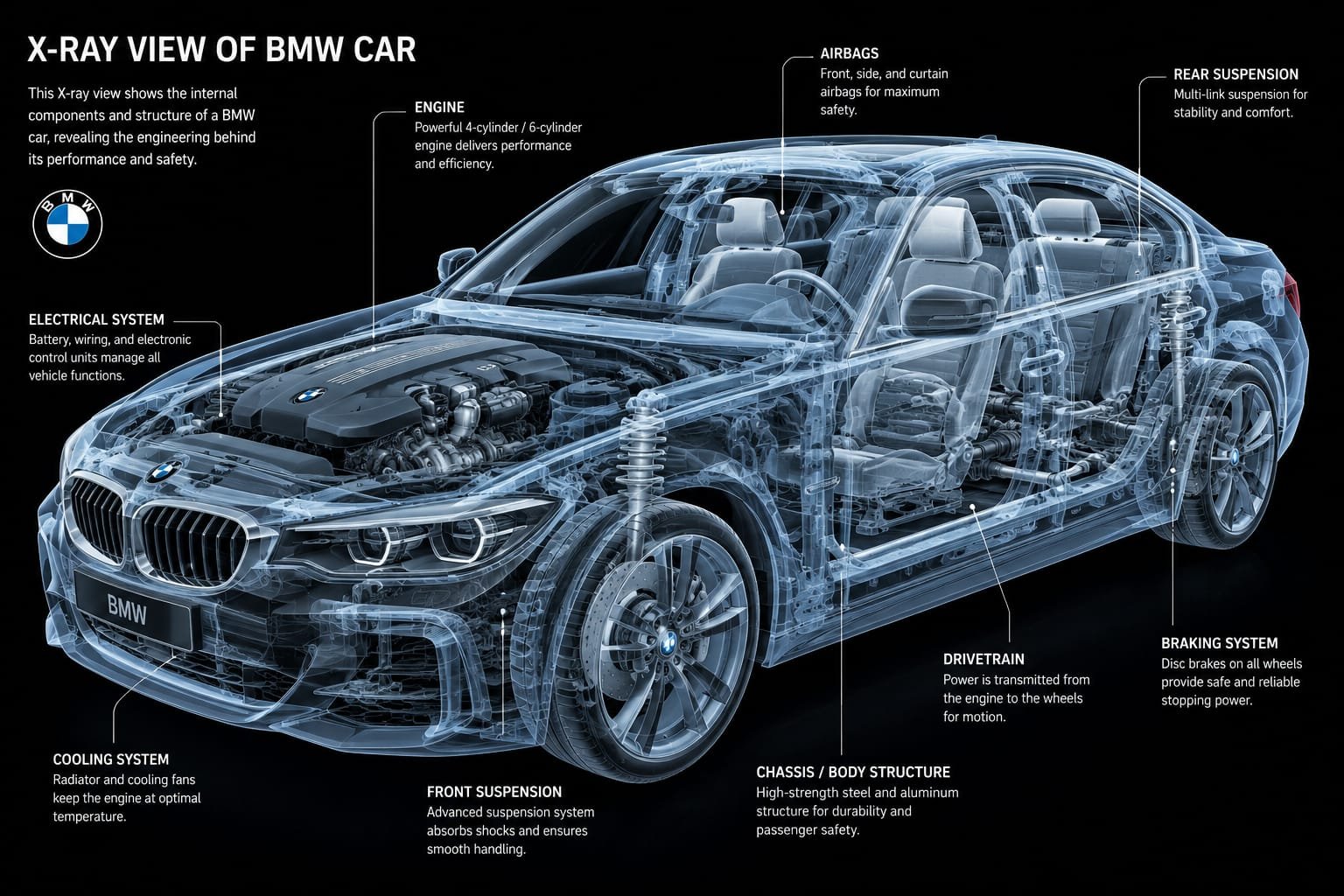
BMW Motorcycle X-Ray — What’s Inside?
BMW Motorcycle X-Ray — What’s Inside This Machine?
What does a BMW motorcycle actually look like underneath its impressive exterior?
From the outside, a BMW motorcycle may appear to be a combination of wheels, bodywork, a fuel tank, an engine and a seat. But inside is a sophisticated network of mechanical, electrical and electronic systems designed to work together.
In this Tech X-Ray exploration, we look beneath the surface of a BMW Motorrad motorcycle and discover the major components that transform fuel and electrical energy into controlled motion.
BMW Motorrad produces several motorcycle families with different engine architectures, including boxer twins, inline four-cylinder engines and six-cylinder engines. Therefore, the exact internal layout depends on the model.
1. The Engine — The Heart of the BMW
The engine is the primary source of mechanical power.
One of BMW Motorrad’s most recognizable engine designs is the flat-twin boxer engine.
In a boxer engine, the two cylinders are positioned horizontally opposite each other. The pistons move outward and inward in opposite directions, creating the characteristic layout and balance of the engine.
BMW has used boxer engines in motorcycles for decades, making the design one of the defining features of BMW Motorrad.
Depending on the BMW motorcycle, the engine may instead be an inline two-cylinder, inline four-cylinder or six-cylinder design.
2. BMW Boxer Engine
The boxer engine is particularly interesting in an X-Ray illustration.
A typical BMW boxer engine contains:
- Two horizontally opposed cylinders
- Pistons
- Piston rings
- Connecting rods
- Crankshaft
- Cylinder heads
- Camshafts
- Valves
- Spark plugs
- Combustion chambers
- Oil passages
- Cooling passages
- Fuel injectors
The cylinders extend outward from the central crankcase.
This arrangement gives the motorcycle a distinctive engine shape that can be clearly seen in a transparent or X-ray-style illustration.
3. BMW ShiftCam Technology
Some modern BMW boxer motorcycles use BMW ShiftCam technology.
ShiftCam changes the intake-side valve timing and valve lift according to operating conditions.
The system uses different cam profiles for different operating conditions.
A lower-load cam profile is designed to support smooth operation and efficiency, while the higher-load profile is designed to provide stronger performance.
BMW explains that its ShiftCam system uses a one-piece intake camshaft with different cam profiles and an actuator that shifts the camshaft axially.
In an X-Ray image, this would be an excellent component to highlight with a label:
BMW ShiftCam → Variable Intake Valve Timing & Lift
4. Pistons and Combustion Chambers
Inside each cylinder is a piston.
The piston moves back and forth as combustion takes place.
The four basic stages of a four-stroke engine are:
- Intake
- Compression
- Power
- Exhaust
The combustion pressure pushes the piston, and the connecting rod transfers this force to the crankshaft.
The crankshaft converts this reciprocating movement into rotation.
That rotational energy eventually becomes rear-wheel drive.
5. Cylinder Heads
The cylinder heads sit at the outer ends of the boxer engine.
They contain important components such as:
- Intake valves
- Exhaust valves
- Camshafts
- Valve springs
- Spark plugs
- Combustion chambers
The cylinder heads are particularly visible on a BMW boxer motorcycle because the cylinders extend horizontally from the engine.
This is one of the easiest features to identify in a BMW X-Ray.
6. Fuel Injection System
Modern BMW motorcycles use electronic fuel-management systems.
The fuel system can include:
- Fuel tank
- Fuel pump
- Fuel filter
- Fuel lines
- Fuel injectors
- Throttle bodies
- Sensors
- Electronic engine management
The injector delivers fuel into the intake system according to commands from the engine-management system.
The quantity and timing of fuel delivery can change according to engine speed, throttle position, temperature and other operating conditions.
7. Air Intake System
The engine also needs a controlled supply of air.
Air generally travels through:
Air Intake → Air Filter → Throttle Body → Intake System → Cylinder
The air filter removes dust and particles before the air reaches the engine.
The throttle system controls how much air enters the engine.
8. Crankshaft
At the center of the engine is the crankshaft.
The pistons are connected to the crankshaft through connecting rods.
The crankshaft performs an important conversion:
Piston movement → Crankshaft rotation
The rotating crankshaft provides the mechanical power that is transferred through the drivetrain.
9. Clutch
The clutch connects and disconnects the engine from the transmission.
When the rider changes gear, the clutch allows engine power to be temporarily interrupted.
BMW motorcycles can use different clutch designs depending on the model.
Some models also feature anti-hopping or slipper-clutch technology.
10. Gearbox / Transmission
The gearbox converts engine speed and torque into useful drive ratios.
A motorcycle transmission contains:
- Gears
- Shafts
- Bearings
- Shift mechanism
- Selector forks
- Clutch connection
Different gears allow the motorcycle to operate efficiently at different speeds.
BMW Motorrad uses different drivetrain arrangements across its motorcycle range.
11. Shaft Drive — A Distinctive BMW Feature
One of the most interesting things to show in a BMW motorcycle X-Ray is the shaft-drive system.
Unlike a chain-driven motorcycle, a shaft-drive BMW can transfer power from the gearbox to the rear wheel through a driveshaft and rear differential/final-drive assembly.
The basic power path is:
Engine → Clutch → Gearbox → Driveshaft → Final Drive → Rear Wheel
BMW describes its Paralever/cardanic system as using a cardan shaft between the gearbox and rear wheel, integrated into the rear suspension architecture on applicable models.
This makes the drivetrain look very different from a conventional chain-and-sprocket motorcycle.
12. Paralever Rear Suspension
The Paralever system is another distinctive BMW engineering feature.
It combines rear-wheel suspension and shaft-drive architecture.
The system is designed to reduce unwanted suspension effects associated with shaft-drive torque reactions.
The rear assembly can include:
- Swingarm
- Driveshaft
- Universal joints
- Rear differential/final drive
- Suspension strut
- Rear wheel
- Brake assembly
BMW describes the Paralever system as a parallelogram-type arrangement that helps compensate for forces generated by the cardan drive.
For your X-Ray graphic, this would be an excellent callout:
PARALEVER → Rear Suspension + Shaft Drive
13. Telelever Front Suspension
Some BMW motorcycles use another distinctive system called Telelever.
Unlike a conventional motorcycle fork, Telelever separates some of the wheel-guidance and suspension functions.
The front wheel is guided by fork tubes, while a separate wishbone-like component and central spring/damper arrangement perform important suspension functions.
BMW states that the Telelever design separates wheel alignment from suspension/damping functions and is intended to reduce front-end dive under braking.
In an X-Ray image, the Telelever should be highlighted clearly because it is one of BMW Motorrad’s most recognizable chassis technologies.
14. Front Wheel and Brake System
The front wheel is connected to the suspension and braking system.
Major components include:
- Wheel rim
- Tire
- Wheel bearings
- Axle
- Brake disc
- Brake caliper
- Brake pads
- Brake lines
When the rider applies the brake, hydraulic pressure moves the brake pads against the disc, converting kinetic energy into heat.
15. Rear Wheel
The rear wheel receives the engine’s final mechanical output.
On shaft-drive BMW models, the power path reaches the rear wheel through the driveshaft and final-drive assembly.
The rear wheel assembly may contain:
- Wheel
- Tire
- Brake disc
- Brake caliper
- Final-drive housing
- Bearings
- Axle
16. BMW Frame — The Skeleton
The frame provides the structural foundation of the motorcycle.
It supports and connects:
- Engine
- Steering system
- Fuel tank
- Suspension
- Seat
- Rear frame
- Electrical equipment
The exact frame construction depends on the BMW model.
For example, BMW’s R 1300 GS introduced a redesigned sheet-metal shell main frame and a die-cast aluminum rear section.
17. Fuel Tank
The fuel tank stores the motorcycle’s fuel.
Inside or around the tank assembly can be components associated with:
- Fuel pump
- Fuel-level sensor
- Fuel pickup
- Fuel lines
- Ventilation system
The fuel then travels toward the injection system.
18. Cooling System
The engine produces substantial heat during combustion.
Depending on the BMW model, cooling can involve:
- Air
- Oil
- Liquid coolant
- Radiators
- Cooling passages
- Water pump
- Thermostat
- Cooling fan
Modern BMW boxer engines can use air/liquid cooling depending on the generation and model.
The cooling system helps keep engine temperatures within their intended operating range.
19. Exhaust System
After combustion, exhaust gases leave the cylinders through the exhaust valves.
The exhaust path generally includes:
Cylinder → Exhaust Port → Header → Catalytic Converter → Muffler
The exhaust system performs several functions:
- Removes combustion gases
- Reduces exhaust noise
- Helps control emissions
- Manages exhaust flow
BMW motorcycles can use electronically controlled engine-management and catalytic-converter systems to manage emissions and performance.
20. Electrical System
Modern BMW motorcycles contain an extensive electrical network.
It can include:
- Battery
- Alternator/generator
- Starter motor
- ECU
- Sensors
- Relays
- Fuses
- Wiring harness
- Headlight
- Turn indicators
- Brake lights
- Instrument display
- Electronic control modules
The electrical system powers everything from starting the engine to controlling sophisticated rider-assistance functions.
21. ECU — The Electronic Brain
The electronic control unit receives information from sensors and controls various motorcycle systems.
Depending on the model, electronic systems can monitor:
- Engine speed
- Throttle position
- Engine temperature
- Wheel speed
- Air conditions
- Gear position
- Brake conditions
- Acceleration
- Motorcycle movement
The ECU and other control modules can then adjust engine and chassis functions.
22. ABS and Electronic Rider Assistance
BMW motorcycles can be equipped with advanced electronic rider-assistance systems.
Depending on model and equipment, these can include:
- ABS
- Traction control
- Riding modes
- Hill-start assistance
- Engine-brake control
- Dynamic brake control
- Tire-pressure monitoring
- Electronic suspension control
- Cruise control
For example, BMW’s R 1300 GS includes systems such as Dynamic Traction Control, Engine Drag Torque Control, Dynamic Brake Assist and Hill Start Control.
These systems make the motorcycle much more electronically sophisticated than older motorcycles.
23. Battery
The battery provides electrical energy for starting and operating electrical systems.
It works together with the motorcycle’s charging system.
The basic electrical cycle is:
Battery → Electrical Systems
and while the engine runs:
Engine → Alternator → Charging System → Battery
24. Dashboard and TFT Display
Many modern BMW motorcycles use digital displays.
Depending on the model, the display can provide information such as:
- Speed
- RPM
- Gear
- Fuel level
- Engine temperature
- Riding mode
- Navigation
- Trip information
- Warning messages
- Connectivity information
This is effectively the rider’s information center.
25. Sensors — The Hidden Network
One of the most interesting things about a modern BMW X-Ray is the number of sensors hidden throughout the motorcycle.
Sensors can monitor:
- Wheel speed
- Engine position
- Engine temperature
- Throttle position
- Air conditions
- Brake conditions
- Motorcycle acceleration
- Lean or movement conditions
The information is sent to electronic control systems that continuously adjust motorcycle operation.
26. What the BMW X-Ray Reveals
If we remove the exterior bodywork using an X-Ray effect, the motorcycle can be divided into several layers.
Outer Layer
- Fuel tank
- Seat
- Body panels
- Headlight
- Windscreen
- Mudguards
Structural Layer
- Frame
- Subframe
- Steering assembly
- Swingarm
Mechanical Layer
- Boxer engine
- Clutch
- Gearbox
- Driveshaft
- Final drive
- Brakes
- Suspension
- Wheels
Electrical Layer
- Battery
- ECU
- Sensors
- Wiring
- Lighting
- Display
Control Layer
- ABS
- Traction control
- Riding modes
- Engine management
- Electronic suspension
- Rider-assistance systems
27. How Does a BMW Motorcycle Move?
The basic power path on a shaft-drive BMW can be simplified as:
Fuel + Air → Combustion → Pistons → Crankshaft → Clutch → Gearbox → Driveshaft → Final Drive → Rear Wheel
At the same time:
Handlebar → Steering System → Front Wheel
For suspension:
Road → Wheels → Suspension → Frame
And for braking:
Brake Control → Hydraulic System → Brake Calipers → Brake Discs → Wheels
All of these systems operate together within fractions of a second while the motorcycle is moving.
28. Why BMW Engineering Is Different
BMW motorcycles are particularly interesting because BMW Motorrad has developed distinctive engineering solutions over many years.
The boxer engine provides a recognizable low-mounted opposed-cylinder layout.
Telelever can separate steering and suspension functions at the front.
Paralever works with shaft drive at the rear on applicable models.
Modern electronic systems then add another layer of control.
This combination creates a motorcycle that is mechanically complex but designed to provide predictable and controlled performance.
29. The Most Interesting Parts to Highlight in a Tech X-Ray
For your Tech X-Ray website, these should be the main clickable BMW components:
🔵 ENGINE
See the pistons, crankshaft, valves and combustion chambers.
🔵 BOXER ENGINE
Understand why BMW’s cylinders sit horizontally opposite each other.
🔵 SHIFTCAM
See how variable valve timing and lift work.
🔵 GEARBOX
Explore the gears and shifting mechanism.
🔵 SHAFT DRIVE
Follow the power from the gearbox to the rear wheel.
🔵 PARALEVER
Explore BMW’s rear suspension and shaft-drive arrangement.
🔵 TELELEVER
See how BMW’s distinctive front suspension works.
🔵 BRAKES + ABS
Explore the brake discs, calipers and electronic braking control.
🔵 ELECTRONICS
Discover the ECU, sensors, battery and wiring network.
🔵 COOLING
See how heat is removed from the engine.
30. Final Takeaway
A BMW motorcycle is not simply an engine mounted between two wheels.
It is a carefully integrated system of:
Engine + Transmission + Drivetrain + Frame + Suspension + Brakes + Electronics + Rider Controls
The engine produces the power.
The gearbox controls how that power is used.
The shaft drive can transfer that power to the rear wheel.
Telelever and Paralever manage important suspension functions on applicable models.
The braking system converts motion into controlled stopping.
The ECU and sensors continuously monitor and manage the motorcycle.
And underneath everything is the frame—the structural backbone holding the entire machine together.