Honda Bike X-Ray — What’s Inside?
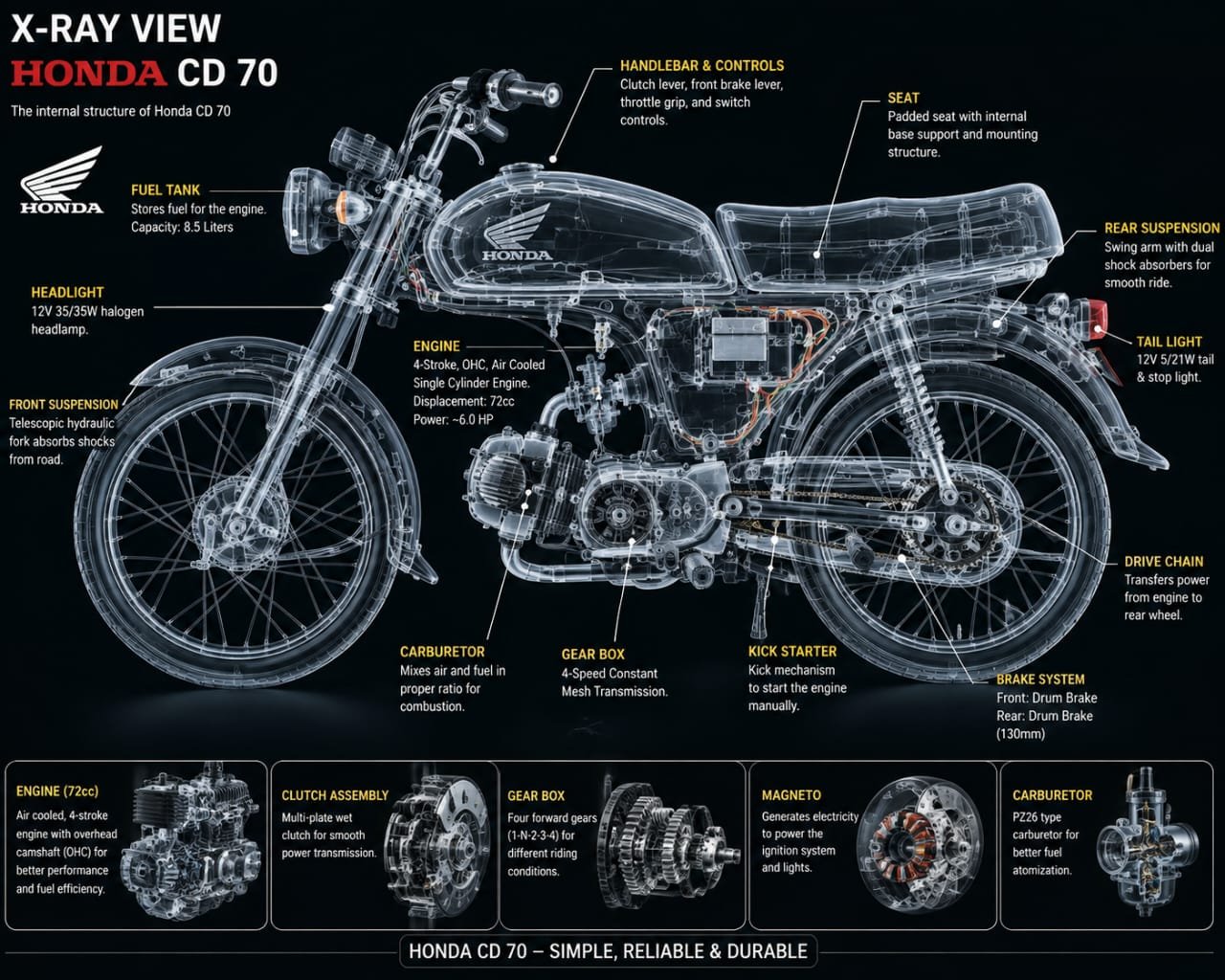
Honda Bike X-Ray — What’s Inside?
Ever wondered what is actually hidden inside a Honda motorcycle?
From the outside, a Honda bike may look simple—two wheels, a fuel tank, an engine and a seat. But beneath its body is a carefully engineered system of mechanical, electrical and structural components working together to produce power, control speed, provide braking and keep the motorcycle stable.
In this X-Ray-style exploration, we look beneath the outer bodywork and identify the major components that make a Honda motorcycle work.
1. Engine — The Heart of the Motorcycle
The engine is the main power-producing unit of the motorcycle.
Depending on the Honda model, the engine configuration can vary considerably. Small commuter motorcycles, scooters, sport bikes and large touring motorcycles use different engine designs and technologies.
Inside a conventional four-stroke motorcycle engine, the major components include:
- Cylinder
- Piston
- Piston rings
- Connecting rod
- Crankshaft
- Valves
- Camshaft
- Spark plug
- Combustion chamber
- Engine oil passages
- Cooling system
- Crankcase
When the engine is running, the piston moves inside the cylinder. The connecting rod transfers this movement to the crankshaft, which converts the piston’s reciprocating motion into rotational motion.
That rotation ultimately becomes the mechanical power used to turn the rear wheel.
2. Fuel System
The fuel system supplies the engine with the fuel it needs for combustion.
Modern Honda motorcycles commonly use programmed fuel injection (PGM-FI), although the exact system depends on the model and market.
The fuel system can include:
- Fuel tank
- Fuel pump
- Fuel filter
- Fuel injector
- Throttle body
- Fuel lines
- Engine control electronics
In a fuel-injected system, the electronic control system determines how much fuel should be delivered according to operating conditions.
This helps provide responsive engine operation and efficient fuel use. Honda describes PGM-FI as a computerized fuel-injection system used across its motorcycle range.
3. Air Intake System
An engine needs both fuel and air.
Air enters through the intake system and passes through the air filter before reaching the engine.
The system may include:
- Air intake
- Air filter
- Air box
- Throttle body
- Intake manifold
- Intake valves
The air filter is particularly important because it helps prevent dust and other particles from entering the engine.
4. Combustion Chamber
Inside the cylinder is the combustion chamber.
This is where the air-fuel mixture is burned.
The basic four-stroke cycle consists of:
- Intake
- Compression
- Power
- Exhaust
The spark plug ignites the compressed mixture in a gasoline engine. The resulting combustion creates pressure that pushes the piston downward.
That movement is transferred through the connecting rod to the crankshaft.
5. Crankshaft and Connecting Rod
The crankshaft is one of the most important moving components inside the engine.
The piston moves up and down, while the crankshaft rotates.
The connecting rod links these two components and transfers the piston’s force to the crankshaft.
The crankshaft then provides rotational power that can be transferred through the transmission and final drive to the rear wheel.
6. Transmission and Clutch
Engine power cannot simply be sent directly to the rear wheel.
The transmission allows the motorcycle to use different gear ratios.
A typical manual motorcycle drivetrain can include:
- Clutch
- Primary drive
- Transmission gears
- Gear selector mechanism
- Countershaft
- Final drive
The clutch allows the rider to temporarily disconnect engine power from the transmission when starting, stopping or changing gears.
The selected gear determines the relationship between engine speed and wheel speed.
7. Final Drive
After passing through the transmission, power reaches the rear wheel through the final-drive system.
Depending on the motorcycle, this can involve:
- Chain and sprockets
- Belt drive
- Shaft drive
Many conventional Honda motorcycles use a chain-and-sprocket arrangement.
The front sprocket transfers rotational force through the chain to the larger rear sprocket, which rotates the rear wheel.
8. Frame — The Skeleton of the Bike
The frame is essentially the motorcycle’s skeleton.
It supports and connects many major components, including:
- Engine
- Fuel tank
- Seat
- Steering assembly
- Rear suspension
- Swingarm
- Electrical components
The frame also plays an important role in handling and stability.
Honda develops different frame structures for different motorcycle categories. For example, Honda’s larger and performance-oriented motorcycles can use highly engineered aluminum or steel chassis designs depending on the model.
9. Front Suspension
The front suspension connects the front wheel to the motorcycle while allowing the wheel to move vertically over bumps.
On many motorcycles, telescopic forks are used.
A conventional fork assembly contains components such as:
- Fork tubes
- Fork sliders
- Springs
- Damping components
- Fork oil
- Triple clamps
The suspension absorbs road impacts and helps keep the front tire in contact with the road.
Honda also uses more specialized suspension designs on certain motorcycles. For example, the Gold Wing uses a double-wishbone front suspension rather than conventional telescopic forks.
10. Rear Suspension
At the rear, the suspension normally works through the swingarm and shock absorber.
Major components can include:
- Swingarm
- Rear shock absorber
- Spring
- Linkage mechanism
- Rear axle
Honda’s Pro-Link system, used on various models, uses a linkage arrangement to provide progressive suspension characteristics.
11. Braking System
The brakes convert the motorcycle’s motion into heat through friction, allowing the rider to slow down or stop.
A motorcycle braking system can include:
- Brake lever or pedal
- Brake master cylinder
- Brake fluid
- Brake hose
- Brake caliper
- Brake pads
- Brake disc
- Rear brake assembly
Honda has developed several braking technologies, including Combined Brake Systems and ABS.
ABS monitors wheel speed and can reduce brake pressure when a wheel approaches lock-up, helping maintain stability during hard braking.
Not every Honda motorcycle has the same braking equipment, so the exact system depends on the model.
12. Wheels and Tires
The wheels provide the physical connection between the motorcycle and the road.
Each wheel can contain:
- Rim
- Tire
- Inner components depending on wheel design
- Wheel bearings
- Axle
- Brake disc or drum
The tires provide traction for:
- Acceleration
- Braking
- Cornering
- Stability
Tire pressure is also important because incorrect pressure can affect handling, braking and tire wear.
13. Steering System
The steering system allows the rider to control the direction of the motorcycle.
Major components include:
- Handlebar
- Steering stem
- Triple clamps
- Fork assembly
- Steering bearings
When the rider turns the handlebar, the steering assembly changes the direction of the front wheel.
14. Electrical System
Modern motorcycles contain considerably more electronics than older motorcycles.
The electrical system can include:
- Battery
- Alternator/stator
- Regulator/rectifier
- Starter motor
- ECU
- Ignition system
- Sensors
- Wiring harness
- Fuses
- Relays
- Headlight
- Turn signals
- Brake lights
- Instrument cluster
The battery supplies electrical energy for starting and various electrical systems, while the charging system replenishes the battery when the engine is running.
15. ECU — The Motorcycle’s Electronic Brain
On electronically controlled Honda motorcycles, the Engine Control Unit (ECU) receives information from sensors and controls various engine functions.
Depending on the motorcycle, sensors can monitor things such as:
- Engine temperature
- Throttle position
- Intake conditions
- Engine speed
- Crankshaft position
- Oxygen/exhaust conditions
- Wheel speed on electronically equipped models
The ECU uses this information to control systems such as fuel injection and ignition.
More advanced Honda motorcycles can also use electronic systems to manage traction, braking and other riding functions.
16. Cooling System
Engine combustion generates considerable heat.
Depending on the motorcycle design, cooling may be provided by:
- Air cooling
- Liquid cooling
- Oil cooling or combinations of cooling technologies
A liquid-cooled engine generally includes:
- Radiator
- Coolant
- Water pump
- Thermostat
- Cooling passages
- Hoses
- Cooling fan
The cooling system helps maintain the engine within its intended operating temperature range.
17. Exhaust System
After combustion, exhaust gases must leave the engine.
The exhaust system can include:
- Exhaust valve
- Exhaust port
- Exhaust header
- Exhaust pipe
- Catalytic converter
- Muffler
The system carries exhaust gases away from the engine while helping reduce noise and, on equipped models, harmful emissions.
18. Fuel Tank
The fuel tank stores the motorcycle’s fuel.
Inside or around the fuel tank assembly you may find components associated with:
- Fuel pump
- Fuel-level sensing
- Fuel pickup
- Fuel lines
- Tank ventilation
The exact arrangement varies between Honda motorcycle models.
19. Battery and Charging System
The motorcycle’s battery provides electrical power when required, especially during starting.
The charging system generally includes:
- Alternator/stator
- Regulator/rectifier
- Battery
The alternator generates electrical power while the engine runs. The regulator/rectifier manages the generated electricity so it can be used by the motorcycle’s electrical system and battery.
20. What an X-Ray View Reveals
When the motorcycle’s exterior bodywork is visually removed, the relationship between its components becomes much easier to understand.
You can imagine the motorcycle as several interconnected layers:
Outer Layer
- Fuel tank
- Side covers
- Mudguards
- Headlight
- Seat
- Body panels
Structural Layer
- Frame
- Swingarm
- Steering assembly
- Subframe
Mechanical Layer
- Engine
- Clutch
- Transmission
- Chain and sprockets
- Suspension
- Brakes
- Wheels
Electrical Layer
- Battery
- ECU
- Sensors
- Wiring
- Ignition
- Lighting
Together, these systems form one complete motorcycle.
How Does a Honda Motorcycle Move?
The basic power path can be simplified as:
Fuel → Engine → Crankshaft → Clutch → Transmission → Final Drive → Rear Wheel
At the same time:
Handlebar → Steering System → Front Wheel
And for stopping:
Brake Control → Brake System → Wheel → Tire → Road
The suspension works continuously between the wheels and chassis to help maintain contact with the road.
Why Is the Honda Motorcycle Designed This Way?
A motorcycle must balance several competing requirements:
- Low weight
- Strength
- Stability
- Fuel efficiency
- Engine performance
- Rider comfort
- Braking performance
- Suspension performance
- Reliability
- Emissions control
Honda uses different engineering solutions depending on the intended purpose of the motorcycle.
A small commuter bike may prioritize simplicity, economy and practicality, while a high-performance sport bike may prioritize acceleration, cornering, braking and electronic control.
Important Note
There is no single internal layout shared by every Honda motorcycle.
A Honda commuter motorcycle, scooter, sport bike, adventure motorcycle and Gold Wing can have substantially different engines, transmissions, frames, suspension systems and electronics.
Therefore, an actual X-ray illustration should be labeled according to the specific Honda model and year being shown.
Final Takeaway
A Honda motorcycle is much more than an engine with two wheels.
Inside its body is a coordinated system of mechanical structures, moving components, electronics, fuel and air systems, suspension, brakes and drivetrain components.
The engine creates the power, the transmission manages that power, the final drive sends it to the wheel, the frame holds the machine together, the suspension manages road movement, and the braking and electronic systems help the rider control it.
That’s what makes the Honda motorcycle an impressive piece of mechanical engineering—and an excellent subject for an X-ray-style exploration.
Tech X-Ray: See Beyond the Surface.
Quick Information
Subject: Honda Bike X-Ray — What’s Inside?
Category: Vehicles
Published: August 26, 2026
Related X-Rays